Im Jahr 2014 wurden die Feste und Bräuche der Lausitzer Sorben im Jahreslauf in das Verzeichnis des immateriellen Kulturerbes der Bundesrepublik Deutschland aufgenommen. Damit wird das Engagement der Sorben, ihre einzigartige lebendige kulturelle Identität zu bewahren, anerkannt.
Deutschland erarbeitet sich im Rahmen der entsprechenden UNESCO-Konvention ein eigenes Register des immateriellen Kulturerbes, wo z. B. unter anderem der Blaudruck, die Heidelberger HipHop-Kultur und der Kölner Karneval vertreten sind. So werden die kulturellen Besonderheiten des Landes hervorgehoben.
Weiterer UNESCO-Fakt: Bereits 2005 veröffentlichte die UNESCO den Atlas bedrohter Sprachen. Darin ist Obersorbisch als „bedrohte“ Sprache eingestuft und Niedersorbisch als „stark bedroht“.

Immaterielles Kulturerbe
Sorbische Bräuche und Traditionen sind Teil des immateriellen Kulturerbes Deutschlands (UNESCO) – ein Zeichen für ihre kulturelle Einzigartigkeit und Lebendigkeit. Dieses Erbe wollen wir aktiv bewahren.
Liste der gesellschaftlichen Bräuche und Feste der Lausitzer Sorben im Jahreslauf

Ptaškowa swajźba (niedersorbisch) | Ptači kwas (obersorbisch) | Vogelhochzeit
> Brandenburg/Sachsen
Die Vogelhochzeit (25.01.) ist vor allem bei Kindern sehr beliebt. Es ist ein Bescherbrauch - die Vögel „bedanken“ sich sozusagen bei den Kindern für das Füttern im Winter.
Am Vorabend der Vogelhochzeit stellen die Kinder Teller auf das Fensterbrett. Am nächsten Tag finden sie darauf Gebäck in Form von Vögeln und Nestern oder andere Süßwaren.
Ursprünglich wurde die Vogelhochzeit in der Oberlausitz gefeiert. Erzieherinnen und Grundschullehrerinnen brachten den Brauch später in die Niederlausitz.
Seit den 1960er Jahren ist die Vogelhochzeit fester Programmpunkt in vielen Kindergärten und Grundschulen. Die Kinder verkleiden sich als Vögel, ziehen durch das Dorf oder die Stadt und führen kurze Kulturprogramme auf. In den sorbischen Kindergärten tragen sie die regionalspezifischen Hochzeitstrachten und stellen eine traditionelle Hochzeitsgesellschaft dar. Ende des 19. Jahrhunderts gab es erstmals auch Abendveranstaltungen für Erwachsene, die in der Regel ein Hochzeitsbitter moderierte. Seit Mitte des 20. Jahrhunderts gestaltet das heutige Sorbische National-Ensemble die Kulturprogramme, oftmals eine Mischung aus Estrade mit folkloristischen Elementen und Revue. Das Programm wird an verschiedenen Orten in der Lausitz aufgeführt, in der Niederlausitz meist im Zusammenhang mit dem „Zapust“ (Fastnacht). Für Kinder gibt es eine eigens entwickelte, professionelle Darbietung.

Zapust (niedersorbisch) | Póstnicy (obersorbisch) | Sorbische/Wendische Fastnacht
> Brandenburg/Sachsen
Siehe Zampern und Festumzug der Jugend

Camprowanje (niedersorbisch/obersorbisch) | Zampern
> Brandenburg/Sachsen
Verkleidete Personen ziehen in verschiedenen Heischegruppen (Jugendliche, Verheiratete, Kinder, neuerdings auch gemischte Gruppen) von Haus zu Haus und werden dabei von Musikanten begleitet. Früher gab es spezifische Zampererkostüme: den Erbsstrohbär, den Storch, den Schimmelreiter, in der Schleifer Region auch den Doppelmenschen und die Eierfrau. Heute kommen Clowns-, Tier- und andere Kostüme hinzu. Nach einem Tanz mit der Hausfrau und einem Glas Schnaps erhalten die Zamperer Eier und Wurst, mittlerweile auch Geld für das „Eieressen“, so nennt man den Tanzabend der jeweiligen Zamperergesellschaft. Die Männerfastnacht mit dem Tanzabend der verheirateten Paare beendet in vielen Dörfern das Zampern. In einigen Dörfern gehen die jungen Frauen zum Tanz in sorbischer Tracht.

Zapust (niedersorbisch) | Festumzug der Jugend
> Brandenburg
Seit dem späten 19. Jahrhundert findet in der Niederlausitz an einem Sonnabend oder Sonntag nach dem Zampern ein Festumzug der Jugend statt, der von Musikanten begleitet wird. Junge Frauen tragen Tanztrachten, die jungen Männer einen schwarzen Anzug und Hut. Ein aus Papierblumen gefertigter Zapuststrauß ziert Hut oder Revers. Nach dem Eröffnungstanz im Saal besucht der Festumzug Honoratioren des Ortes wie z.B. den Bürgermeister, Pfarrer oder verdienstvolle Einwohner. Als Dank für eine Gabe in die Fastnachtskasse und einen kleinen Imbiss wird dann eine Ehrenrunde getanzt und ein Zapuststräußchen überreicht. Der Festumzug endet abends mit dem Fastnachtstanz, zu dem alle Einwohner eingeladen sind.
Jatšowne nałogi (niedersorbisch) | Jutrowne nałožki (obersorbisch) | Osterbräuche
Viele Osterbräuche gehen auf vorchristliche Frühlingsriten zurück (z.B. Palmweihe, Quellen- und Feuerweihe, Umritte). Heute werden einige überregional (z.B. Ostersingen, Osterwasserholen, Ostereierverzieren), andere regional ausgeübt (in der Niederlausitz Osterfeuer, in der Oberlausitz Osterschießen, Waleien, in der katholischen Region „Kreuzsingen“, Klappern, Osterreiten).

Jatšowne jaja (niedersorbisch) | Jutrowne jeja (obersorbisch) | Ostereier
> Brandenburg/Sachsen
Traditionell waren reich verzierte Eier (zusätzlich zu Lebkuchen oder Osterbrötchen) ein Ostergeschenk für Kinder, vor allem Patenkinder, früher auch für das Gesinde, den Pfarrer, Küster oder Lehrer und natürlich auch als Zeichen der Zuneigung und Liebe unter der Jugend. Noch heute ist es in einigen Regionen der Lausitz üblich, dass sich Kinder ihr Patengeschenk abholen, meistens am Gründonnerstag. Für das Verzieren werden vier verschiedene Techniken angewendet - die Wachsbatiktechnik, Kratztechnik, die Ätztechnik und seit den 1980er Jahren das Bossieren.

Walkowanje (niedersorbisch/obersorbisch) | Waleien
> Brandenburg/Sachsen
Dies ist ein beliebtes Spiel, heute vor allem bei Kindern in der Niederlausitz und im Gebiet um Slepo|Schleife. Über eine künstlich angelegte Bahn („walka“) im Garten oder auf dem Dorfanger werden gekochte, meist gefärbte Eier hinabgerollt. Als geschlagen galt das Ei, das von einem anderen getroffen wurde. In Budyšin | Bautzen ging aus dem Waleien das Eierschieben hervor, das Vereine Ende des 19. Jahrhunderts zu einem überregionalen Volksfest mit Jahrmarktsstimmung entwickelten. Bautzener Bürger „schoben“ gekochte Eier, Äpfel oder Gebäck für die unterhalb des Hrodźišćo | Protschenberg stehenden Kindern hinab. In der DDR galt der Brauch als diskriminierend und wurde 1960 unterbunden. Seit 2001 erfreut sich das „Bautzener Eierschieben“ mit vielfältigem, auch sorbischem kulturellem Begleitprogramm erneut großer Beliebtheit.

Klepotanje (obersorbisch) | Klappern
> Sachsen
Nach der Heiligen Stunde am Gründonnerstagabend schweigen in der katholischen Lausitz die Glocken. In einigen Dörfern ziehen am Karfreitag und Ostersamstag Jungen – jüngst auch Mädchen – früh, mittags und abends mit Holzklappern durch das Dorf und beten vor Bildstöcken und Kreuzen. Unterwegs klappern sie laut, um alle Gläubigen zur Andacht und zum Gebet einzuladen.

Jutrowne třělenje (obersorbisch) | Osterschießen
> Sachsen
Das Lärmen in der Osternacht zur Vertreibung böser Geister war vor allem im 19. Jahrhundert sehr verbreitet. Heute konzentriert es sich auf die südliche Oberlausitz, wo mit Zündplättchen, Knallkorken oder Karbid(kanonen) geschossen wird.

Jatšowne spiwanje (niedersorbisch) | Jutrowne spěwanje (obersorbisch) | Ostersingen
> Brandenburg/Sachsen
Das Singen von Passionsliedern in der Passionszeit und Auferstehungs-liedern/Osterchorälen in der Osternacht war bis in die 1950/60er Jahre bei den evangelischen Sorben weit verbreitet. Der Brauch geht ursprünglich auf die aus Spinnstuben hervorgegangenen Singgemeinschaften der Mädchen zurück. Das Ostersingen begann oft schon vier Wochen vor Ostern, zog sich durch die Passionszeit und endete am Ostersonntag bei Sonnenaufgang mit Auferstehungsliedern.
Im Kirchspiel Slepo | Schleife singen seit 1993 in der Osternacht einige Frauen in Tracht, die “Kantorki”. In der Kirche zu Dešno | Dissen in der Niederlausitz singt seit 2001 am Karfreitag traditionell der Chor “Łužyca” und seit 2011 singen auch in Janšojce | Jänschwalde junge Frauen in der Osternacht. In einigen Dörfern der Kirchgemeinde Kulow | Wittichenau pflegen junge Frauen bis heute in der Fastenzeit und am Gründonnerstag das Kreuzsingen, am Karfreitag das Grab- und in der Osternacht das Auferstehungssingen.

Jatšowny wogeń (niedersorbisch) | Jutrowny woheń (obersorbisch) | Osterfeuer
> Brandenburg/Sachsen
In der Nacht zum Ostersonntag werden in mehr als 120 Dörfern der Niederlausitz und einigen Orten der mittleren Lausitz um Mitternacht Osterfeuer entzündet. In der Nacht wird von den Dorfburschen allerlei Schabernack getrieben. In katholischen Gemeinden wird die Osterkerze, z.B. am Osterfeuer vor der Kirche, angezündet.

Jatšowna wóda (niedersorbisch) | Jutrowna woda (obersorbisch) | Osterwasser
> Brandenburg/Sachsen
Eine besondere Kraft wird dem Osterwasser, dem im Frühling erneuerten Wasser, zugesprochen. Mädchen und junge Frauen holen am Ostersonntag vor Sonnenaufgang schweigend frisches Quellwasser. Wird das Schweigegebot nicht eingehalten, verliert es seine besondere Wirkung und wird zum „Plapperwasser“. Früher hat man sich mit dem Wasser gewaschen und das Vieh besprengt.

Jatšowne rejtarje (niedersorbisch) | Křižerjo (obersorbisch) | Osterreiten
> Brandenburg/Sachsen
Die Osterreiterprozessionen sind der bedeutendste sorbische katholische Brauch, der alljährlich am Ostersonntag viele Gäste aus nah und fern anzieht. Es ist nicht nur Tradition, sondern es ist ein beeindruckendes öffentliches Glaubensbekenntnis. Obwohl es ein katholischer Brauch ist, nehmen auch evangelische Männer teil.
Festlich gekleidete Männer in einem schwarzen Gehrock und mit einem Zylinder auf dem Kopf reiten auf geschmückten Pferden. Kirchenlieder singend und betend reiten sie in die Nachbargemeinde und verkünden die freudige Botschaft von der Auferstehung Jesu Christi.

Palenje chódotow (niedersorbisch) | Chodojtypalenje (obersorbisch) | Hexenbrennen
> Brandenburg/Sachsen
Das Hexenbrennen in der Walpurgisnacht (30.04.) ist ein Frühlingsbrauch, bei dem der Winter vertrieben wird. Bei diesem wird ein hohes, weithin sichtbares Feuer entfacht. In der Oberlausitz ist der Brauch weit verbreitet, in der Niederlausitz eher in den Gemeinden, die kein Osterfeuer pflegen. An einer geeigneten Stelle wird ein „Hexenhaufen“ aus trockenem Holz und anderem brennbarem Altmaterial errichtet, der bis zum Hexenbrennen bewacht wird, um zu verhindern, dass die Jugend der Nachbarorte ihn vorzeitig anzündet.
In einigen Dörfern wird obenauf eine aus Stroh und alten Kleidungsstücken gefertigte „Hexe“ gesetzt. Seit 1963 veranstaltet die Gemeinde Hodźij | Göda in Sachsen das Gödaer Hexenbrennen als Volksfest, ursprünglich vom Bautzener Theater ins Leben gerufen. Im Mittelpunkt steht eine Gerichtsverhandlung, eine jährlich neu bearbeitete, satirische Anklageschrift und die Entzündung des großen Hexenhaufens.

Meja (niedersorbisch/obersorbisch) | Maibaum
> Brandenburg/Sachsen
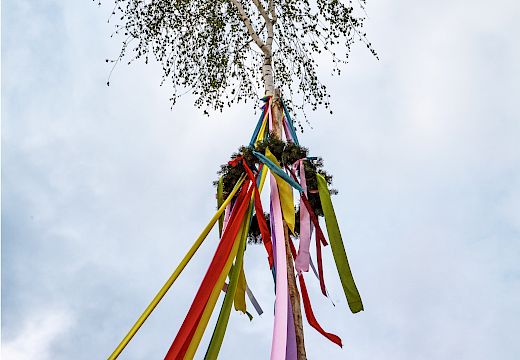
Bei diesem Frühlingsbrauch stellt die Jugend am Vorabend des 1. Mai einen Maibaum auf: einen entrindeten Baumstamm, an dessen Spitze eine Birke mit bunten Bändern, mitunter einer sorbischen Fahne, befestigt ist. Außerdem umwindet den Baum eine Girlande aus Tannenzweigen und unterm Wipfel schmückt ein Tannenkranz mit Bändern (oft in den Farben der sorbischen Fahne blau-rot-weiß). In der Zeit bis zum Maibaumwerfen wird der Maibaum von den Jugendlichen bewacht, um das vorzeitige Absägen durch Jugendliche aus der Nachbardörfer zu verhindern.
In der Oberlausitz wird das Maibaumwerfen meist an einem Sonntag durchgeführt. Die Jugend tanzt um den Maibaum, oft tragen die jungen Frauen Trachten. Sobald der Baum fällt, rennen die Jungen, um nach dem Wipfel zu greifen. Der Erste ist Maikönig und wählt sich aus dem Kreis der Frauen seine Maikönigin. In der Niederlausitz steht der Maibaum oft bis zum Johannistag (24. Juni), wird dann gefällt und versteigert.

Bože ćěło (obersorbisch) | Fronleichnam
> Sachsen
An Fronleichnam, dem Donnerstag zehn Tage nach Pfingsten, und am darauffolgenden Sonntag finden wie anderorts in Deutschland in der sorbischen katholischen Region Prozessionen statt. Der Prozessionsweg zu einem Altar im Freien ist mit frischem Gras bestreut und von junge Birken umsäumt. Auch die Kirche wird mit Birkenbäumchen geschmückt. An vielen Häusern und vom Kirchturm wehen Fahnen des Vatikan und/oder sorbische Fahnen. Während der Prozession streuen Mädchen Blumen, Bläser begleiten die zahlreichen Gläubigen beim Singen sorbischer Kirchenlieder. Viele Mädchen tragen die Brautjungferntracht sowie Frauen die sorbisch-katholische Festtracht.
Bis Anfang der 1970er Jahre trugen Frauen außerdem das sogenannte Fronleichnamstuch. Heute sieht man dieses gestärkte weiße Tuch nur vereinzelt, es wird jedoch von jüngeren Frauen in einigen Kirchgemeinden wieder eingeführt.

Jańske rejtowanje (niedersorbisch) | Johannisreiten
> Brandenburg
Das Johannisreiten ist ein sommerlicher Brauch mit Reiterspiel zum Johannistag (24.06.), der Mitte des 19. Jahrhunderts in mehreren Dörfern der Niederlausitz gefeiert wurde und heute nur noch in Kózłe|Casel gepflegt wird. Träger ist heute nicht mehr die Dorfjugend, sondern ein eigens dafür gegründeter Traditionsverein. Im Mittelpunkt steht die Figur des Jan (dtsch. Johann). Ein junger Mann wird von Mädchen und jungen Frauen mit Kornblumenranken benäht, Arme und Beine werden mit Wicke umwunden. Für den Kopf wird eine kronenähnliche Maske angefertigt. Das Gerüst ist aus Schilfrohr und wird mit Gartenblumen und Seerosen umwunden. Ist der Jan vollständig geschmückt, reitet er gemeinsam mit Jungen des Dorfes vom Gasthof aus zum Festplatz, begleitet von einer Blaskapelle. Vor den Reitern gehen die Mädchen und jungen Frauen in weißen, mit blauen und roten Streifen besetzten Kleidern. Sie tragen eine zweite Krone, die der Johann am Abend beim Ehrentanz überreicht bekommt. Auf dem Festplatz angekommen, reitet der Jan zunächst einige Male mit seinem gesamten Gefolge über den Platz, vor etlichen Zuschauern. Nach einigen Ritten scheiden die Begleiter aus. Nun versuchen die Zuschauer, den Jan anzuhalten und seine Blumen zu erhaschen, da sie als Glücksbringer gelten.
Žnjowne nałogi (niedersorbisch) | Žnjenske nałožki (obersorbisch) | Erntebräuche
Auch anlässlich des Einbringens der Getreideernte werden Bräuche mit traditionellen Reiterspielen gepflegt. Der kokot (dtsch. Hahn) tritt dabei in verschiedenen Sinnzusammenhängen auf; so als Bezeichnung für die letzte Garbe, die von den Schnittern mit bunten Blumen und Bändern geschmückt wurde. Dabei riefen sie früher: „źins jo kokot – heut ist kokot“. Das verdeutlicht, dass die letzte Garbe, der Hahn, vom Feld ist. Die Männer bekamen einst Sträuße aus Ähren angesteckt. Die Frauen fertigten Erntekränze und eine große Erntekrone, womit sie auf dem Gutshof das Ende der Getreideernte bekannt gaben. Danach wurde gefeiert und es fanden verschiedene Wettspiele statt, bei denen „der alte Hahn“ symbolisch oder auch reell getötet wurde.

Kokot - Zabijanje kokota (niedersorbisch) | Hahnschlagen
> Brandenburg
Eine ältere Form der Erntespiele ist das Hahnschlagen. Einst in der gesamten Lausitz verbreitet, wird es heute nur noch in wenigen Dörfern der Niederlausitz gepflegt. Das Hahnschlagen geschieht nicht mehr in seiner ursprünglichen Form, bei der ein Hahn mit Dreschflegeln erschlagen wurde, sondern nur noch symbolisch. In Smogorjow | Schmogrow bei Burg/Spreewald suchen die jungen Männer mit verbundenen Augen mit einem Dreschflegel nach einem umgestürzten Topf, unter dem der Hahn sitzt. Jeder hat drei Versuche. Wer den Topf als erster trifft, wird König und hascht aus den sich im Kreise um ihn herum drehenden jungen Frauen in Tanztracht nach einer Königin. Anschließend lassen die Jungen den Hahn frei, um ihn dann wieder einzufangen und zu versteigern.

Kokot - Łapanje kokota (niedersorbisch) | Hahnrupfen
> Brandenburg
Die am weitesten verbreitete Form der Erntespiele ist das Hahnrupfen. Am Querbalken einer eigens dafür errichteter, mit Laub umwundenen Pforte wird kopfüber ein toter Hahn angebunden. Junge Männer galoppieren auf Pferden nacheinander unter der Pforte hindurch und versuchen dem toten Hahn den Kopf abzureißen. Wem das gelingt, der wird erster König („kral“); die Burschen, die die Flügel erhaschen, werden zweiter bzw. dritter König. Sie erhalten große Siegerkränze aus Eichenlaub. Die drei Erntekönige wählen sich aus dem Kreis der jungen Frauen, welche die Tanztracht tragen, mit verbundenen Augen ihre Partnerin aus, um mit dieser die Ehrenrunde zu tanzen. Die Frauen ermitteln aus ihrer Mitte bei Geschicklichkeitsspielen wie dem Froschkarren, Junggesellenkarren oder Eierlaufen die Erntekönigin. Sie bekommt ebenfalls als Preis einen Eichenlaubkranz umgehängt. Zum Abschluss der Wettspiele geht es im festlichen Zug zum Tanz ins Gasthaus. In diesem Festzug wird auch die mit bunten Bändern geschmückte Erntekrone getragen.

Rejtowanje wó kołac (niedersorbisch) | Stollenreiten
> Brandenburg
Das Stollenreiten ist ein ehemaliger Pfingstbrauch, auch Teil des Hochzeitszeremoniells, bei dem die unverheirateten Gäste um einen großen Kuchen oder Stollen ritten. Heute wird der Brauch noch in Nowa Niwa | Neu Zauche am Nordrand des Spreewaldes als Erntebrauch im August gepflegt. Das Fest beginnt am Vormittag mit einem Gottesdienst der Dorfjugend. Die Frauen tragen die Kirchgangtracht. Bevor es am Nachmittag zum Wettreiten und den Wettspielen der jungen Frauen auf das abgeerntete Feld geht, werden die Preise für die Sieger präsentiert: drei unterschiedlich große mit Blumen und Spargelkraut geschmückte Stollen. Die jungen Männer reiten in weißen Leinenhosen und -hemden auf ungesattelten Pferden um die Wette und ermitteln so den schnellsten Reiter. Die jungen Frauen ermitteln bei Geschicklichkeitsspielen ihre Besten.

Kolo rajtowanje (obersorbisch – Schleifer Dialekt) | Ringreiten
> Sachsen
Im Kirchspiel Schleife fand das Wettreiten zur Ermittlung des Erntekönigs statt, bei dem eine Stange durch einen an einer Girlande hängenden kleinen Kranz gestochen werden musste. Der König erwählte sich seine Königin oder bekam sie nach Mädchenwettkämpfen zugewiesen. Heute versuchen in Brězowka | Halbendorf bei Slepo | Schleife Reiterinnen und Reiter im Galopp in mehreren Durchgängen einen Speer durch einen Ring aus Eichenlaub zu werfen. Der bzw. die Beste bekommt von den Mädchen des Dorfes den Pokal überreicht. Die Jugend führt einen Reigentanz auf, bei dem die Jungen festlich gekleidet sind und die Mädchen die Schleifer Tanztracht tragen.

Kjarmuša (niedersorbisch) | Kermuša (obersorbisch) | Kirmes
> Brandenburg/Sachsen
Die kermuša (dt. Kirmes) wird alljährlich in Erinnerung an die Kirchweihe gefeiert. In der Vergangenheit war es das wichtigste Fest für die bäuerlichen Gesellschaft. Meist wurde drei Tage lang gefeiert und es bot Möglichkeit zum Sattessen, zum Besuch bei Verwandten und zum Tanz. In der literarischen Erinnerung lebt sie vom Gegensatz zwischen dem kargen bäuerlichen Alltag und einer rauschhaften Festtagsstimmung, die von Großzügigkeit und Geselligkeit geprägt war.
In evangelischen sowie katholischen Pfarrgemeinden wird sie bis heute an Sonntagen zwischen dem Bartholomäustag (24.08.) und dem Tag der hl. Katharina (25.11.) gefeiert. Im Mittelpunkt stehen der Besuch der Familie und das reichhaltige Essen. Vielerorts sind auf Festtagswiesen Karussells und Buden aufgestellt.

Pśěza (niedersorbisch) | Přaza (obersorbisch) | Spinte
> Brandenburg/Sachsen
Die „Spinte“ (Spinnstube) war die wichtigste, aus kollektiver Arbeit hervorgegangene Gemeinschaft im Dorf. Nach Abschluss der Ernte im Herbst versammelten sich abends die unverheirateten Mädchen, um das nötige Pensum an Garn zu spinnen, aus dem die im Haushalt benötigte Leinwand hergestellt wurde. Während der Arbeit wurden – unter anderem – unter Anleitung der „Kantorka“ Lieder eingeübt, die zu Hochzeiten oder Beerdigungen vorgetragen werden konnten. Die Gesellschaft der Spinnstube, zu der nach getaner Arbeit auch die ledigen Burschen Zutritt hatten, plante und gestaltete die Feste der Jugend im Laufe des Jahres („Zapust“, Ostersingen, Maibaum, „Kokot“) und gilt daher bis zu Beginn des 20. Jahrhunderts als Trägerin vieler sorbischer/wendischer Bräuche. Im Kirchspiel Slepo|Schleife fungiert die Spinnstube heute als Treff für Frauen und Männer aller Altersklassen, wobei es besonders um die Pflege der Gemeinschaft und der sorbischen Sprache geht. In der Niederlausitz widmen sich Heimatvereine und Domowina-Gruppen unter der Bezeichnung „Spinte“ traditionellen Handwerkstechniken und dem regionalen Liedgut.
Gódowe nałogi (niedersorbisch) | Hodowne nałožki (obersorbisch) | Advents- und Weihnachtsbräuche

Spěwanje na swjateho Měrćina (obersorbisch) | Martinssingen
> Sachsen
Der Heischegang der Kinder am St. Martinstag (11.11.) wird in der katholischen Region in der Oberlausitz (außer in der Kirchgemeinde Radwor | Radibor) gepflegt. Die Kinder gehen in kleinen Gruppen von Haus zu Haus und bitten unter Abgesang traditioneller sorbischer Heischeverse um Naschereien.

Borborka (obersorbisch) | Heilige Barbara
> Sachsen
Der Bescherbrauch am Vorabend des Barbaratages (04.12.) wird heute vor allem in einigen Dörfern der Kirchgemeinde Kulow | Wittichenau gepflegt. Die Borborka (dt. Heilige Barbara) geht in Begleitung von zwei Ruprechten von Haus zu Haus. Sie trägt ein weißes Brautkleid und einen Schleier vor dem Gesicht. Den Kindern beschert sie Äpfel, Nüsse und Süßigkeiten.

Swjaty Mikławš (obersorbisch) | Heiliger Nikolaus
> Sachsen
Der Bescherbrauch am Nikolaustag (06.12.) ist wohl bekannt in ganz Deutschland. In einigen Dörfern der Kirchgemeinde Kulow | Wittichenau geht der Swjaty Mikławš (dt. Heiliger Nikolaus) als Bischof gekleidet von Haus zu Haus und überreicht den Kindern Süßigkeiten. An vielen Orten putzen die Kinder am Vorabend ihre Schuhe. Am Nikolaustag warten dann als Dank Obst und Süßigkeiten im Schuh.
In der Kirchgemeinde Radwor | Radibor pflegen Kinder den Brauch als Heischegang und gehen von Haus zu Haus.

Swjata Marija hospodu pyta (obersorbisch) | Heilige Maria auf Herbergssuche
> Sachsen
In einigen katholischen Orten der Oberlausitz ist es in der Adventszeit - traditionell beginnt es am 15.12., neun Tage vor Weihnachten - üblich, eine Marienfigur und mancherorts auch gemeinsam mit einer Joseffigur von Haus zu Haus zu tragen. So wird symbolisch die biblische Szene der Herbergssuche nachgestellt. In jedem Haus bleibt die Marienfigur eine Nacht, um dann weitergereicht zu werden. Die Reihenfolge der beteiligten Haushalte wird ausgelost oder nach Bedarf ermittelt. Bei Einzug sowie während der Beherbergung werden Gebete gesprochen und Kirchlieder gesungen. Der letzte Haushalt darf die Figur bis zum nächsten Advent „beherbergen“.

Janšojski Bog (niedersorbisch) | Bože dźěćetko (obersorbisch) | Christkind
> Brandenburg/Sachsen
Ein bekannter Bescherbrauch in der Schleifer Region ist der Besuch des Bože dźěćetko (dt. Christkind), in der Niederlausitz bekannt als Janšojski bog. Das dźěćetko besucht in der Vorweihnachtszeit mit zwei Begleiterinnen Familien, aber auch Kindergärten, Schulen oder Seniorenheime. Es trägt eine mit Elementen der Brauttracht geschmückte Festtracht, weiße Handschuhe und vor dem Gesicht eine Tüllspitze. In den Händen hält es ein Glöckchen und die mit bunten Schleifen besteckte, Segen spendende Lebensrute. Schweigend streichelt es die Wange der Beschenkten.

Nowolětka (niedersorbisch/obersorbisch) | Neujährchen
> Brandenburg, Sachsen
Zu Neujahr und zum Dreikönigstag wurden Gebildebrote in Tiergestalt, sogenannte Neujährchen, und um Wittichenau „Dreizacken“ („třodraki“) gebacken, die dem Vieh unter das Futter gemischt wurden, damit es gesund bleibe. Sie galten auch als traditionelle Gaben der Kinder für ihre Paten. Aus dem Brauch, der sich vereinzelt bis in die 1920er Jahre erhalten hat, entwickelte sich eine neue Tradition, welche vor allem in Schulen und Kindergärten gepflegt wird. Hier formen und backen Kinder verschiedene Tierfiguren, um sie zu verschenken. Das Museum „Alte Pfefferküchlerei“ in Weißenberg hat sich ebenfalls diesem Brauch verschrieben. Zusammen mit den Besuchern werden dort in der Winterzeit solche Gebildebrote gefertigt.

Woklapnica (niedersorbisch) | Woklapnica (obersorbisch) | „Abklopfen“
> Brandenburg, Sachsen
Öffentliche Gemeindeversammlung zum „Abklopfen“ des vergangenen Jahres ist die Zeit um den Dreikönigstag (06.01.). Nach dem Bericht des Ortsvorstehers bzw. Bürgermeisters werden Gemeindeangelegenheiten öffentlich diskutiert; die neu Zugezogenen „kaufen sich ein“ mit einer Saalrunde Schnaps. In den 1950er Jahren fand die Woklapnica nur noch in Kupaŕske Bórkowy | Burg-Kauper statt. Seit den 1990er Jahren erfährt sie in der Niederlausitz wieder wachsenden Zuspruch. Im Kirchspiel Slepo|Schleife wird sie auf dem Nepila-Hof Rohne e.V. durchgeführt.