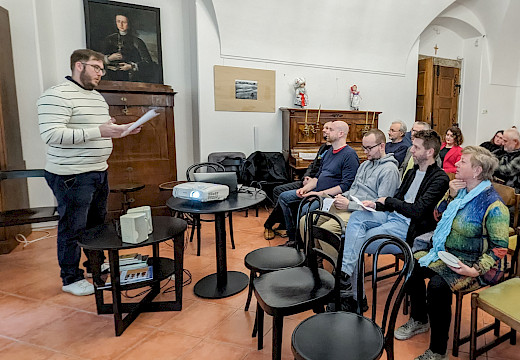
The regional federations – Jakub Lorenc-Zalěski (district of Zhorjelc | Görlitz), Handrij Zejler (region of Wojerecy | Hoyerswerda), Jan Arnošt Smoler (region of Budyšin | Bautzen), Michał Hórnik (region of Kamjenc | Kamenz) and the regional federation of Lower Lusatia (Brandenburg) – serve as hubs for their respective areas. They bring together the activities of Sorbian associations on the ground and strengthen Sorbian identity.
Our specialist associations are active in a wide range of areas, including science, education, performing and visual arts, youth, tourism, culture, music, folk art, religion and sport. This reflects our broad commitment and underlines the diversity of our community.
Each of our member associations contributes with its own focus to the promotion of Sorbian language, culture and identity. The oldest registered association, Maćica Serbska, today serves as a bridge between science and history, language and culture. The Cyrill-Methodius Association is dedicated to the religious dimension, while the Sorbian youth association Pawk focuses on youth work. Sorbian cultural tourism in Lusatia is promoted by the Sorbische Kulturtourismus e.V.
Other associations – such as the Federation of Sorbian Choirs, the Federation of Sorbian Craftspeople and Entrepreneurs, Serbski Sokoł e. V., the Society for the Promotion of the Sorbian National Ensemble, the Sorbian Cultural and Information Centre in Berlin (SKI e. V.) and the Federation of Sorbian Students – all play a crucial role in shaping the Sorbian linguistic, cultural and sport landscape with their specific areas of expertise.
Domowina is proud to be firmly rooted as the representative of the Sorbian people in Brandenburg and Saxony. Our member associations are indispensable partners in this effort – together, we are shaping the future of the Sorbian people
Our regional associations
Regional Association Lower Lusatia
Founded in 1991, the Domowina Regional Association Lower Lusatia (registered association) brings together the former district associations of Chóśebuz | Cottbus, Gubin | Guben, Kalawa | Calau (Lubin | Lübben) and Grodk | Spremberg. With more than 2,000 members in over 35 local groups and 19 associations, it serves as the umbrella organisation for Sorbian/Wendish cultural and language work in Bramborska | Brandenburg. The Association promotes Sorbian identity through language, customs and traditions, and actively advocates for minority rights in Bramborska | Brandenburg. It raises interest in Sorbian issues, particularly among young people, through events such as Zapust (Shrovetide carnival), Jańske rejtowanje (St John’s riding procession) and Kokot (rooster feather plucking). Through initiatives such as the WITAJ educational concept in nurseries, schools and after-school care centres, it ensures linguistic and cultural continuity. Despite the historical processes of Germanisation, the Association actively works to counter language loss and strengthens the self-confidence of the Sorbian minority through dedicated youth work and cultural projects.
The Domowina Regional Association “Michał Hórnik”, Kamenz (registered association), based in the former district of Kamjenc | Kamenz, which includes several Catholic villages with a Sorbian majority population, benefits from the close connection between religion and national identity. Sorbian traditions, including traditional costumes and customs, are actively maintained during church celebrations. Named after Michał Hórnik, an important promoter of Sorbian literature, the Association comprises four local groups and 21 Sorbian cultural, village and youth associations with more than 1,000 members. Each year, it organises numerous events that strengthen cultural ties and social cohesion. In addition to traditional activities such as folklore and the preservation of customs, the Association also promotes contemporary art, music and literature. The Roman Catholic Church plays a significant role by holding services in the Sorbian language. It connects generations and provides a living linguistic space. Schools represent another key environment for the Sorbian language. The preservation of Sorbian schools is therefore essential for the continued existence of the Sorbian people.
The Domowina Regional Association “Jan Arnošt Smoler” in Budyšin | Bautzen plays a key role in preserving and fostering the Sorbian language and culture in Lusatia. With 22 local groups and a clear focus on language maintenance and cultural activities, the Association promotes bilingualism and cultural exchange through events such as lectures, concerts and traditional festivals. The Association works closely with educational institutions, supports bilingual initiatives and represents the interests of the Sorbian people in the Budyšin | Bautzen region at various political levels. Despite challenges such as declining membership numbers and the effects of globalisation, it remains committed to encouraging active participation, particularly among the younger generation. The Regional Association emphasises the importance of Sorbian culture in contemporary society and actively promotes the use of the language in everyday life. Through partnerships and cooperation, it helps ensure that Sorbian traditions continue to thrive.
The Domowina Regional Association “Handrij Zejler”, based in Wojerecy | Hoyerswerda, comprises five local groups as well as numerous heritage, traditional costume, dance and cultural associations. Named after the Sorbian pastor and poet Handrij Zejler, the Association is committed to preserving and revitalising the Sorbian language, culture and traditions in the region. Through readings, concerts, festivals and educational activities, it strengthens the bicultural character of Lusatia and promotes bilingualism in everyday life. Through its engagement, the Association contributes to making Sorbian heritage visible and to creating new spaces for the use of the language.
The Domowina Regional Association “Jakub Lorenc-Zalěski” is committed to preserving the Sorbian language and culture in the district of Zhorjelc | Görlitz. Particular emphasis is placed on the Schleife dialect (slepjanšćina), which is to be certified as an official language in order to secure a future for Sorbian in Slepo | Schleife and the Mužakowska hola | Muskau Heath. The Regional Association operates in a challenging geographical context, as the existence of Sorbian villages is threatened by lignite mining. It actively participates in discussions on resettlement and advocates for the preservation of Sorbian life in the affected areas. In addition, the Association promotes the involvement of young people in Sorbian activities, particularly through bilingual educational programmes.
Maćica Serbska (registered association), founded as a Sorbian scholarly society and one of the oldest Sorbian associations, is dedicated to the research and promotion of Sorbian history, language and culture. The Association leads the Upper and Lower Sorbian Language Commissions as well as the Heritage Committee, with the aim of strengthening Sorbian national awareness. In addition to its academic work, Maćica Serbska promotes exchange between Sorbs and Germans and fosters cooperation with neighbouring Slavic peoples. Through its sections for history, literature, art, folklore studies and music, the Association is committed to researching Sorbian heritage and advancing Sorbian scholarship. In 1993, Maśica Serbska was established as the Lower Sorbian section of Maćica Serbska.
The Sorbian Youth Association Pawk (registered association) was founded in 1994 and has since promoted cultural exchange among Sorbian young people. As a member of the Youth of European Nationalities (YEN), the Association maintains international contacts; for example, it supports the Roskilde Festival and organises projects such as “Students Help Pupils”. The aim of the Association is to create spaces in which young people can use the Sorbian language and to strengthen their Sorbian identity. Pawk also supports cultural and musical projects in order to actively involve young people in preserving Sorbian heritage. An important partner is the Sorbian Grammar School Budyšin | Bautzen, with which the Association works closely to implement educational and leisure projects.
Founded in 1991, the Sorbian School Association (registered association) is committed to bilingual early childhood education and multilingual education from primary school to higher education. The Association operates WITAJ nurseries offering bilingual education and supports Sorbian schools in Sakska | Saxony and Bramborska | Brandenburg. The School Association advises parents and cooperates with educational institutions and ministries to ensure that Sorbian interests are anchored in education legislation. It organises language competitions, Sorbian Olympiads and language camps to promote the use of the Sorbian language. In addition to its educational activities, the Association provides study guidance and volunteer programmes for young people in order to strengthen Sorbian identity.
The “Serbski Sokoł” Sports Association (registered association), founded to promote sport and Sorbian awareness, brings together sports clubs and individual members. Most of the clubs were established between 1920 and 1933. Following German reunification, the Association was re-established at the end of 1993 in Hórki | Horka. With members such as Sokoł Budyšin, Grün-Weiß Horka and the Sorbian Grammar Schools in Budyšin | Bautzen and Chóśebuz | Cottbus, Serbski Sokoł coordinates sporting events in Lusatia, particularly in the regions around Budyšin | Bautzen and Kamjenc | Kamenz. In addition to grassroots and competitive sport, the Association promotes regional identity, with Sorbian culture playing a central role. In keeping with the international Sokoł movement, the Association focuses on sport as a means of strengthening social cohesion. Since 1996, Serbski Sokoł has been a member of the Domowina – Federation of Lusatian Sorbs.
The Sorbian Cultural Tourism Association (registered association) was founded in 1996. The Association promotes interest in Sorbian history, culture and ways of life by presenting Sorbian heritage in the trilingual region of Łužyca | Łužica | Lusatia (Lower Sorbian, Upper Sorbian and German). Through a wide range of events – including exhibitions and markets – the Association contributes to raising awareness of Sorbian folk culture. It also organises workshops on traditional Sorbian crafts such as painting, ceramics and woodwork, helping to keep cultural heritage alive while making it known beyond Lusatia.
The Society for the Promotion of Sorbian Folk Culture (registered association) is committed to preserving and further developing Sorbian traditions through projects and events. It organises markets, exhibitions and workshops that highlight Sorbian crafts such as painting, ceramics and embroidery. Regular meetings between Upper and Lower Sorbs promote cultural exchange and support the continuation of Sorbian traditions. The Society works closely with local artists and craftspeople to preserve and promote Sorbian cultural heritage in Lusatia.
The Cyril and Methodius Association (registered association) is the publisher of Katolski Posoł, the weekly newspaper of the Catholic Sorbs. This publication offers not only spiritual reflections and reports on church life in Lusatia, but also provides information on the current situation of the Church and on religious events worldwide. Readers themselves contribute by submitting their own articles. For many, Katolski Posoł is an indispensable companion on Sundays – a medium that strengthens them in their religious and cultural identity. The Association is also actively committed to promoting Catholic values and preserving Sorbian traditions within the Church.
Founded in 1990, the Society for the Promotion of the Sorbian Cultural and Information Centre in Berlin (SKI) (registered association) promotes a sense of belonging among Sorbs living in Berlin. Serving as a link between Sorbs in the capital and other nationalities, the Association regularly organises cultural events such as readings, concerts and fairs. The monthly Sorbian regulars’ table, Serbske blido, provides Sorbs in Berlin with an opportunity to speak Sorbian and exchange views on current issues. Since 2002, the Association has been a member of the Domowina – Federation of Lusatian Sorbs and is committed to strengthening Sorbian identity in the capital.
Founded in 1952, the Sorbian National Ensemble is dedicated to preserving and promoting Sorbian cultural traditions. The Ensemble brings together three divisions – ballet, choir and orchestra – which both safeguard Sorbian heritage and combine it with contemporary stage art. Although the Ensemble has performed in 40 countries across four continents, bilingual Lusatia remains its central sphere of activity. The Society for the Promotion of the Sorbian National Ensemble (registered association) provides financial support to the Ensemble, fosters dialogue between audiences and artists, and is committed to supporting young talent in Sorbian art.
The Sorbian Choir Association (registered association) was founded in 1923 to preserve Sorbian musical heritage and to promote the choir movement. With 17 member choirs and around 500 members, the Association provides support for legal, financial and organisational cooperation. It organises concerts and competitions and is committed to promoting young talent in order to keep the rich choir traditions of the Sorbian people alive and to engage both Sorbian- and German-speaking audiences with a diverse musical repertoire.
Founded in 1997, the Sorbian Craftspeople and Entrepreneurs’ Association (registered association) is committed to promoting bilingualism in Lusatia and representing the interests of Sorbian businesses. The Association has more than 60 members and offers bilingual apprenticeship opportunities. It maintains economic relations with Poland and the Czech Republic and promotes cultural and economic exchange. A particular focus lies on creating professional prospects within the region.
The Sorbian Students’ Association (registered association) was founded in 1991 and brings together Sorbian students in various university cities in Germany and abroad. Larger groups are based in Dresden, Leipzig and Berlin. The Association promotes exchange among Sorbian students through regular meetings, cultural programmes and the annual publication of the satirical newspaper Šeršeń. Through events such as the “Schadźowanka” and joint hiking excursions, the Association keeps the Sorbian language and culture alive among students.
The Sorbian Artists’ Association (registered association) (SKB) brings together artists, journalists and cultural practitioners who are committed to Sorbian art and culture. It promotes and enhances the visibility of Sorbian art in the fields of painting, music, literature, theatre, film and publishing. Through exhibitions, concerts, readings and workshops, the Association strengthens the presence of Sorbian art in Lusatia and beyond. The SKB maintains international contacts and contributes to a dynamic exchange between Sorbian and German cultural life.
This website is using cookies to provide a good browsing experience.
These include essential cookies that are necessary for the operation of the site, as well as others that are used only for anonymous statistical purposes, for comfort settings or to display personalized content. You can decide for yourself which categories you want to allow. Please note that based on your settings, not all functions of the website may be available.
Privacy Information
In the following privacy information, we, as the controller within the meaning of the General Data Protection Regulation (GDPR), explain which personal data we process when you visit our website and use our online services.
Please note that, as a standard, all data transmissions in connection with our website take place via an encrypted connection. We reserve the right to amend this privacy information from time to time to ensure that it always complies with current legal requirements or to reflect changes to our services. We therefore recommend that you read the privacy information regularly to stay informed about the protection of the personal data we process.
Controller
Domowina – Zwězk Łužyskich Serbow | Zwjazk Łužiskich Serbow | Bund Lausitzer Sorben e. V. Póstowe naměsto | Postplatz 2 Serbski dom | Haus der Sorben 02625 Budyšin | Bautzen Germany
Access to the Website, Logging and Log Files In order to access our website, the processing of your IP address and further access information is technically necessary for the duration of your session. In addition, access information is logged and stored in the server log files. This includes:
IP address
browser type and version
operating system used
referrer URL
hostname of the accessing computer
date and time of the request
Personal data is processed for the purpose of providing the website (Art. 6(1)(b) GDPR) and to ensure the security of our information technology systems (Art. 6(1)(c) GDPR in conjunction with Art. 32 GDPR). Log files are deleted after seven days at the latest.
Use of Cookies We use cookies on our website. Cookies allow us to optimise the information and services on our website for users. They enable us to recognise users of our website in order to make it easier for them to use. Cookies are used on our website in connection with the following services:
Matomo – Usage Analysis With your consent pursuant to § 25(1) TDDDG in conjunction with Art. 4 No. 11 and Art. 7 GDPR, we use the web analytics service Matomo for statistical analysis of the use of our website. The processing of personal data associated with this use is based on your consent (Art. 6(1)(a) GDPR).
Matomo uses cookies to analyse website usage. The following data in particular is processed:
anonymised IP address
date and time of page access
pages accessed and duration of visit
referrer URL
technical information about the device, browser and operating system Processing takes place exclusively on our own server. No personal data is transferred to third parties. Data collected by Matomo is stored for six months and then deleted. It is stored solely for the purpose of analysing and optimising our website.
Google Search Console We use Google Search Console, a service provided by Google Ireland Limited, Gordon House, Barrow Street, Dublin 4, Ireland. Google Search Console helps us analyse the visibility of our website in Google Search and identify technical and content-related opportunities for optimisation. In particular, Google Search Console provides us with information about the search queries through which our website appears in or is accessed via Google Search, as well as statistical data such as impressions, clicks, click-through rates and average position. Based on our current technical implementation, the use of Google Search Console on our website does not set any additional cookies or use any additional tracking technologies on users' devices. The data obtained through Google Search Console is also analysed within our web analytics system, Matomo. For this purpose, the search and performance data made available by Google Search Console is imported into Matomo via a server-side API. No visitor data collected by Matomo is transferred to Google as part of this process. The processing is carried out on the basis of Article 6(1)(f) GDPR. Our legitimate interest lies in analysing and improving the visibility, technical discoverability and user-friendliness of our website.
YouTube, Google Ireland Limited – Display of Video Content With your consent pursuant to § 25(1) TDDDG in conjunction with Art. 4 No. 11 and Art. 7 GDPR, we use the YouTube embedding function to display and play YouTube videos. The associated processing of personal data is based on your consent (Art. 6(1)(a) GDPR).
Use of YouTube involves the transfer of personal data by Google Ireland Limited to Google LLC in the United States. This transfer is based on Art. 45(1) GDPR in conjunction with the EU–U.S. Data Privacy Framework.
When video content is displayed, the user’s IP address and further browser-related information are transmitted to Google. When videos are embedded using enhanced privacy mode, no additional personal data is processed beyond this. Further information is transmitted to Google only when you actively click to play the video. If you are logged into YouTube at the time, Google assigns this information to your user account.
For details regarding the purpose and scope of data processing by Google and your rights and settings options for protecting your privacy, please refer to Google’s privacy policy.
In addition, only strictly necessary cookies pursuant to § 25(2) No. 2 TDDDG are used on our website. The subsequent processing of personal data is based on Art. 6(1)(b) GDPR for the purpose of identifying users and ensuring proper technical functionality of the content management system (“wires”, “wires_challenge”).
Other Integrated Services Darüber hinaus sind auf unserer Internetseite weitere folgende Dienste eingebunden:
Adobe Fonts, Adobe Systems Software Ireland Limited – We use Adobe Fonts (formerly Typekit), provided by Adobe Systems Software Ireland Limited, to ensure consistent font presentation. The integration of Adobe Fonts is based on our legitimate interest pursuant to Art. 6(1)(f) GDPR. This interest lies in the technically sound, consistent and visually appealing presentation of our website and licence monitoring by Adobe.
When accessing our website, connection data, including the user’s IP address, is transmitted to Adobe servers. According to Adobe, no cookies are set in connection with Adobe Fonts and the IP address is used solely to provide the fonts.
Newsletter To provide our newsletter service, we integrate a form provided by our service provider Positive Group Deutschland GmbH (Rapidmail) on the basis of legitimate interest pursuant to Art. 6(1)(f) GDPR. A data processing agreement pursuant to Art. 28 GDPR has been concluded.
Subscription to the newsletter is based on your consent (Art. 6(1)(a) GDPR). Only your email address is required. To verify your details and consent, you will receive a confirmation email (double opt-in). We log:
email address
IP address
date and time of registration and confirmation
You may withdraw your consent at any time with future effect by using the unsubscribe link included in every newsletter email. Your stored email address will then be deleted.
Contact Form Our website provides a contact form and contact via email. When you contact us, we process the personal data you provide (in particular name, email address and message) for the purpose of responding to your enquiry. Processing is based on legitimate interest (Art. 6(1)(f) GDPR) or, in the case of contractual matters, Art. 6(1)(b) GDPR.
Your data will be treated confidentially and will not be passed on to third parties unless necessary to handle your enquiry. Data is deleted once your enquiry has been fully resolved, unless statutory retention obligations apply.
Use of Service Providers We use service providers for hosting and technical support who may process personal data on our behalf or have access to it. Data processing agreements pursuant to Art. 28 GDPR have been concluded with all such providers. In addition to those already mentioned, these include:
Data Subject Rights and Right to Lodge a Complaint
You have the right to:
obtain information about your personal data
request rectification
request erasure
request restriction of processing
request data portability
Where processing is based on legitimate interests, you also have the right to object. Where processing is based on consent, you may withdraw your consent at any time with future effect. You may exercise your rights using the contact details provided above. You also have the right to lodge a complaint with a supervisory authority pursuant to Art. 77 GDPR if you believe that your personal data is being processed unlawfully.
If you would like, I can also adapt the tone slightly (more formal UK institutional, or more EU-legal neutral).
Imprint / Legal Notice
Domowina – Zwězk Łužyskich Serbow | Zwjazk Łužiskich Serbow | Bund Lausitzer Sorben e. V. Serbski dom | Haus der Sorben Póstowe naměsto | Postplatz 2 02625 Budyšin | Bautzen Germany
Register of Associations: VerR 30317 Registered Court: Dresden Local Court
Bank details: Deutsche Bank AG IBAN DE42 8 707 0000 0612 3269 00 BIC DEUTDE8CXXX
Tax number: 204/140/0277 (The association is recognised as a non-profit organisation and is exempt from corporation tax.)
Representation
Represented by Judit Šołćina Chief Executive (authorised to represent the association in accordance with its statutes)
Responsible for editorial content in accordance with Section 18 (2) of the German State Media Treaty (MStV): Božena Šimanec | Schiemann Press Officer
Domowina is the provider of the domain www.domowina.de and is responsible for the central content of the main website as well as for the technical structure of the website. Responsibility for the content (in particular texts, images, media, downloads, and external links) of the respective subpages within the multisite structure lies with the respective member organisations and regional associations.
The following organisations are responsible for the content of their respective subpages:
Maćica Serbska e. V.: dr Anja Pohončowa | Pohontsch, Chairwoman
Serbski Sokoł e. V.: Jan Hrjehor | Rehor, Chairman
Society for the Promotion of a Sorbian Cultural and Information Centre in Berlin – SKI e. V.: Cyril Pjech | Cyrill Pech, Chairman
Association for the Promotion of Sorbian Folk Culture e. V.: Franciska Grajcarekowa | Franziska Grajcarek, Chairwoman
Association of Sorbian Craftspeople and Entrepreneurs e. V.: Mónika Cyžowa | Monika Ziesch, Chairwoman
Association of Sorbian Choir e. V.: Pětr Cyž | Peter Ziesch, Chairman
Sorbian Artists’ Association e. V.: Jan Bělk | Bilk, Chairman
Association of Sorbian Students: Matej Mark, Chairman
Liability for Content The contents of this website have been created with the greatest possible care. However, Domowina – Zwězk Łužyskich Serbow | Zwjazk Łužiskich Serbow | Bund Lausitzer Sorben e. V. accepts no liability for the accuracy, completeness or timeliness of the information provided. We reserve the right to amend, supplement or delete content at any time.
Liability for Links This website contains links to external third-party websites over whose content we have no control. We therefore accept no liability for such external content. The respective operators of the linked sites are solely responsible for their content. At the time the links were created, no unlawful content was identifiable.
Content and Copyright: The layout, design, photographs and editorial contributions on this website are protected by copyright. Any reuse or reproduction is permitted for private purposes only. Alterations to the content are not permitted. Public use, publication or distribution of content requires prior consent from Domowina – Zwězk Łužyskich Serbow | Zwjazk Łužiskich Serbow | Bund Lausitzer Sorben e. V.
Official announcements and press releases issued by Domowina may be used provided the source is acknowledged. The regional and member associations of Domowina are solely responsible for the content of their respective websites.
Consumer Dispute Resolution / Universal Arbitration Board We are neither willing nor obliged to participate in dispute resolution proceedings before a consumer arbitration board.
Data Protection Information on data protection can be found in our Privacy Policy.
Funded by
The Domowina – Federation of Lusatian Sorbs is institutionally funded by the Foundation for the Sorbian People, which receives annual grants from public funds on the basis of the approved budgets of the German Bundestag, the Brandenburg State Parliament, and the Saxon State Parliament. www.stiftung.sorben.com
This website is using cookies to provide a good browsing experience.
These include essential cookies that are necessary for the operation of the site, as well as others that are used only for anonymous statistical purposes, for comfort settings or to display personalized content. You can decide for yourself which categories you want to allow. Please note that based on your settings, not all functions of the website may be available.
Privacy Information
In the following privacy information, we, as the controller within the meaning of the General Data Protection Regulation (GDPR), explain which personal data we process when you visit our website and use our online services.
Please note that, as a standard, all data transmissions in connection with our website take place via an encrypted connection. We reserve the right to amend this privacy information from time to time to ensure that it always complies with current legal requirements or to reflect changes to our services. We therefore recommend that you read the privacy information regularly to stay informed about the protection of the personal data we process.
Controller
Domowina – Zwězk Łužyskich Serbow | Zwjazk Łužiskich Serbow | Bund Lausitzer Sorben e. V. Póstowe naměsto | Postplatz 2 Serbski dom | Haus der Sorben 02625 Budyšin | Bautzen Germany
Access to the Website, Logging and Log Files In order to access our website, the processing of your IP address and further access information is technically necessary for the duration of your session. In addition, access information is logged and stored in the server log files. This includes:
IP address
browser type and version
operating system used
referrer URL
hostname of the accessing computer
date and time of the request
Personal data is processed for the purpose of providing the website (Art. 6(1)(b) GDPR) and to ensure the security of our information technology systems (Art. 6(1)(c) GDPR in conjunction with Art. 32 GDPR). Log files are deleted after seven days at the latest.
Use of Cookies We use cookies on our website. Cookies allow us to optimise the information and services on our website for users. They enable us to recognise users of our website in order to make it easier for them to use. Cookies are used on our website in connection with the following services:
Matomo – Usage Analysis With your consent pursuant to § 25(1) TDDDG in conjunction with Art. 4 No. 11 and Art. 7 GDPR, we use the web analytics service Matomo for statistical analysis of the use of our website. The processing of personal data associated with this use is based on your consent (Art. 6(1)(a) GDPR).
Matomo uses cookies to analyse website usage. The following data in particular is processed:
anonymised IP address
date and time of page access
pages accessed and duration of visit
referrer URL
technical information about the device, browser and operating system Processing takes place exclusively on our own server. No personal data is transferred to third parties. Data collected by Matomo is stored for six months and then deleted. It is stored solely for the purpose of analysing and optimising our website.
Google Search Console We use Google Search Console, a service provided by Google Ireland Limited, Gordon House, Barrow Street, Dublin 4, Ireland. Google Search Console helps us analyse the visibility of our website in Google Search and identify technical and content-related opportunities for optimisation. In particular, Google Search Console provides us with information about the search queries through which our website appears in or is accessed via Google Search, as well as statistical data such as impressions, clicks, click-through rates and average position. Based on our current technical implementation, the use of Google Search Console on our website does not set any additional cookies or use any additional tracking technologies on users' devices. The data obtained through Google Search Console is also analysed within our web analytics system, Matomo. For this purpose, the search and performance data made available by Google Search Console is imported into Matomo via a server-side API. No visitor data collected by Matomo is transferred to Google as part of this process. The processing is carried out on the basis of Article 6(1)(f) GDPR. Our legitimate interest lies in analysing and improving the visibility, technical discoverability and user-friendliness of our website.
YouTube, Google Ireland Limited – Display of Video Content With your consent pursuant to § 25(1) TDDDG in conjunction with Art. 4 No. 11 and Art. 7 GDPR, we use the YouTube embedding function to display and play YouTube videos. The associated processing of personal data is based on your consent (Art. 6(1)(a) GDPR).
Use of YouTube involves the transfer of personal data by Google Ireland Limited to Google LLC in the United States. This transfer is based on Art. 45(1) GDPR in conjunction with the EU–U.S. Data Privacy Framework.
When video content is displayed, the user’s IP address and further browser-related information are transmitted to Google. When videos are embedded using enhanced privacy mode, no additional personal data is processed beyond this. Further information is transmitted to Google only when you actively click to play the video. If you are logged into YouTube at the time, Google assigns this information to your user account.
For details regarding the purpose and scope of data processing by Google and your rights and settings options for protecting your privacy, please refer to Google’s privacy policy.
In addition, only strictly necessary cookies pursuant to § 25(2) No. 2 TDDDG are used on our website. The subsequent processing of personal data is based on Art. 6(1)(b) GDPR for the purpose of identifying users and ensuring proper technical functionality of the content management system (“wires”, “wires_challenge”).
Other Integrated Services Darüber hinaus sind auf unserer Internetseite weitere folgende Dienste eingebunden:
Adobe Fonts, Adobe Systems Software Ireland Limited – We use Adobe Fonts (formerly Typekit), provided by Adobe Systems Software Ireland Limited, to ensure consistent font presentation. The integration of Adobe Fonts is based on our legitimate interest pursuant to Art. 6(1)(f) GDPR. This interest lies in the technically sound, consistent and visually appealing presentation of our website and licence monitoring by Adobe.
When accessing our website, connection data, including the user’s IP address, is transmitted to Adobe servers. According to Adobe, no cookies are set in connection with Adobe Fonts and the IP address is used solely to provide the fonts.
Newsletter To provide our newsletter service, we integrate a form provided by our service provider Positive Group Deutschland GmbH (Rapidmail) on the basis of legitimate interest pursuant to Art. 6(1)(f) GDPR. A data processing agreement pursuant to Art. 28 GDPR has been concluded.
Subscription to the newsletter is based on your consent (Art. 6(1)(a) GDPR). Only your email address is required. To verify your details and consent, you will receive a confirmation email (double opt-in). We log:
email address
IP address
date and time of registration and confirmation
You may withdraw your consent at any time with future effect by using the unsubscribe link included in every newsletter email. Your stored email address will then be deleted.
Contact Form Our website provides a contact form and contact via email. When you contact us, we process the personal data you provide (in particular name, email address and message) for the purpose of responding to your enquiry. Processing is based on legitimate interest (Art. 6(1)(f) GDPR) or, in the case of contractual matters, Art. 6(1)(b) GDPR.
Your data will be treated confidentially and will not be passed on to third parties unless necessary to handle your enquiry. Data is deleted once your enquiry has been fully resolved, unless statutory retention obligations apply.
Use of Service Providers We use service providers for hosting and technical support who may process personal data on our behalf or have access to it. Data processing agreements pursuant to Art. 28 GDPR have been concluded with all such providers. In addition to those already mentioned, these include:
Data Subject Rights and Right to Lodge a Complaint
You have the right to:
obtain information about your personal data
request rectification
request erasure
request restriction of processing
request data portability
Where processing is based on legitimate interests, you also have the right to object. Where processing is based on consent, you may withdraw your consent at any time with future effect. You may exercise your rights using the contact details provided above. You also have the right to lodge a complaint with a supervisory authority pursuant to Art. 77 GDPR if you believe that your personal data is being processed unlawfully.
If you would like, I can also adapt the tone slightly (more formal UK institutional, or more EU-legal neutral).
Imprint / Legal Notice
Domowina – Zwězk Łužyskich Serbow | Zwjazk Łužiskich Serbow | Bund Lausitzer Sorben e. V. Serbski dom | Haus der Sorben Póstowe naměsto | Postplatz 2 02625 Budyšin | Bautzen Germany
Register of Associations: VerR 30317 Registered Court: Dresden Local Court
Bank details: Deutsche Bank AG IBAN DE42 8 707 0000 0612 3269 00 BIC DEUTDE8CXXX
Tax number: 204/140/0277 (The association is recognised as a non-profit organisation and is exempt from corporation tax.)
Representation
Represented by Judit Šołćina Chief Executive (authorised to represent the association in accordance with its statutes)
Responsible for editorial content in accordance with Section 18 (2) of the German State Media Treaty (MStV): Božena Šimanec | Schiemann Press Officer
Domowina is the provider of the domain www.domowina.de and is responsible for the central content of the main website as well as for the technical structure of the website. Responsibility for the content (in particular texts, images, media, downloads, and external links) of the respective subpages within the multisite structure lies with the respective member organisations and regional associations.
The following organisations are responsible for the content of their respective subpages:
Maćica Serbska e. V.: dr Anja Pohončowa | Pohontsch, Chairwoman
Serbski Sokoł e. V.: Jan Hrjehor | Rehor, Chairman
Society for the Promotion of a Sorbian Cultural and Information Centre in Berlin – SKI e. V.: Cyril Pjech | Cyrill Pech, Chairman
Association for the Promotion of Sorbian Folk Culture e. V.: Franciska Grajcarekowa | Franziska Grajcarek, Chairwoman
Association of Sorbian Craftspeople and Entrepreneurs e. V.: Mónika Cyžowa | Monika Ziesch, Chairwoman
Association of Sorbian Choir e. V.: Pětr Cyž | Peter Ziesch, Chairman
Sorbian Artists’ Association e. V.: Jan Bělk | Bilk, Chairman
Association of Sorbian Students: Matej Mark, Chairman
Liability for Content The contents of this website have been created with the greatest possible care. However, Domowina – Zwězk Łužyskich Serbow | Zwjazk Łužiskich Serbow | Bund Lausitzer Sorben e. V. accepts no liability for the accuracy, completeness or timeliness of the information provided. We reserve the right to amend, supplement or delete content at any time.
Liability for Links This website contains links to external third-party websites over whose content we have no control. We therefore accept no liability for such external content. The respective operators of the linked sites are solely responsible for their content. At the time the links were created, no unlawful content was identifiable.
Content and Copyright: The layout, design, photographs and editorial contributions on this website are protected by copyright. Any reuse or reproduction is permitted for private purposes only. Alterations to the content are not permitted. Public use, publication or distribution of content requires prior consent from Domowina – Zwězk Łužyskich Serbow | Zwjazk Łužiskich Serbow | Bund Lausitzer Sorben e. V.
Official announcements and press releases issued by Domowina may be used provided the source is acknowledged. The regional and member associations of Domowina are solely responsible for the content of their respective websites.
Consumer Dispute Resolution / Universal Arbitration Board We are neither willing nor obliged to participate in dispute resolution proceedings before a consumer arbitration board.
Data Protection Information on data protection can be found in our Privacy Policy.
Funded by
The Domowina – Federation of Lusatian Sorbs is institutionally funded by the Foundation for the Sorbian People, which receives annual grants from public funds on the basis of the approved budgets of the German Bundestag, the Brandenburg State Parliament, and the Saxon State Parliament. www.stiftung.sorben.com
Your cookie preferences have been saved.
To load this element, it is required to consent to the following cookie category: {category}.