Sorbian customs and traditions form part of UNESCO’s Intangible Cultural Heritage – a recognition of their cultural uniqueness and vitality. At the same time, the classification of the Sorbian languages as endangered serves as a reminder that this heritage must be actively safeguarded.
In 2014, several Sorbian customs and traditions were inscribed on UNESCO’s Register of Intangible Cultural Heritage. This recognition came in response to the commitment of the Sorbs and their efforts to preserve their unique cultural identity. UNESCO’s acknowledgement underlines the international significance of these cultural expressions and supports their continued safeguarding.
As early as 2005, UNESCO published an Atlas of Endangered Languages. In it, Upper Sorbian is classified as “vulnerable” and Lower Sorbian as “severely endangered”.
Liste der gesellschaftlichen Bräuche und Feste der Lausitzer Sorben im Jahreslauf
The Bird Wedding (25 January) is particularly popular among children. It is a gift-giving custom in which the birds “thank” the children for feeding them during the winter. On the evening before, children place plates on the windowsill. The next day they find pastries shaped like birds and nests or other sweets.
Originally, the custom was celebrated in Upper Lusatia and was later introduced to Lower Lusatia by nursery and primary school teachers. Since the 1960s, it has been a fixed part of programmes in many nurseries and primary schools. Children dress up as birds, parade through villages or towns, and present short cultural performances. In Sorbian nurseries, they wear regional wedding costumes and re-enact a traditional wedding party.
Since the late 19th century, evening events for adults have also been held, usually hosted by a wedding announcer. From the mid-20th century onwards, the Sorbian National Ensemble has shaped these programmes, often combining revue formats with folkloric elements. Performances take place across Lusatia, in Lower Lusatia often in connection with “Zapust” (carnival). Special professional performances are also developed for children.
Disguised participants move from house to house in various groups (youths, married couples, children, and now also mixed groups), accompanied by musicians. Traditionally, there were specific costumes such as the straw bear, the stork, the rider on a white horse, and in the Schleife region also the “double person” and the egg woman. Today, clown, animal and other costumes are also common. After dancing with the lady of the house and sharing a drink, participants receive eggs and sausage, and nowadays also money for the so-called “egg feast”, the dance evening of the respective group. In many villages, the men’s carnival with a dance evening for married couples marks the end of Zampern. In some places, young women attend the dance wearing traditional Sorbian costume.
Zapust (Lower Sorbian) | Youth parade
> Brandenburg
Since the late 19th century, a festive youth procession has taken place in Lower Lusatia on a Saturday or Sunday after Zampern, accompanied by musicians. Young women wear dance costumes, while young men wear black suits and hats decorated with a “Zapust bouquet” made of paper flowers. After the opening dance in the hall, the procession visits local dignitaries such as the mayor, priest or respected residents. In return for a donation to the carnival fund and light refreshments, an honorary dance is performed and a bouquet is presented. The procession concludes in the evening with a carnival dance open to all residents.
Many Easter customs originate from pre-Christian spring rituals (e.g. blessing of palms, springs and fire, and processions). Today, some are practised across regions (e.g. Easter singing, fetching Easter water, decorating Easter eggs), while others are region-specific (Easter fires in Lower Lusatia; Easter shooting and egg-rolling in Upper Lusatia; in Catholic areas, cross singing, clapper processions and Easter riding).
Traditionally, richly decorated eggs (in addition to gingerbread or Easter pastries) were given as Easter gifts to children, especially godchildren, and formerly also to servants, the priest, the sexton or the teacher, as well as a sign of affection among young people. In some regions of Lusatia, it is still customary for children to collect their godparent gifts, usually on Maundy Thursday. Four different techniques are used for decorating: wax batik, scratching, etching, and, since the 1980s, embossing.
Walkowanje (Lower Sorbian/Upper Sorbian) | Egg Rolling
> Brandenburg/Saxony
This is a popular game, today mainly among children in Lower Lusatia and in the area around Slepo|Schleife. Hard-boiled, usually coloured eggs are rolled down a specially prepared track (“walka”) in gardens or village greens. An egg is considered defeated if it is struck by another. In Budyšin | Bautzen, this developed into “egg pushing”, which associations expanded into a large public festival with a fair-like atmosphere at the end of the 19th century. Residents rolled eggs, apples or pastries down the slope of Hrodźišćo | Protschenberg to waiting children. The custom was banned in 1960 in the GDR but has been revived since 2001 and is again very popular, accompanied by a varied cultural programme, including Sorbian elements.
Klepotanje in Chrósćicy | Crostwitz, photo: R. Ledźbor
Klepotanje (Upper Sorbian) | Clapper Processions
> Saxony
After the liturgy on Maundy Thursday evening, church bells fall silent in the Catholic parts of Lusatia. In some villages, boys – and more recently also girls – walk through the village on Good Friday and Holy Saturday, morning, midday and evening, carrying wooden clappers and praying at shrines and crosses. The loud clapping calls the faithful to devotion and prayer.
The making of loud noises during Easter night to drive away evil spirits was widespread, especially in the 19th century. Today, it is mainly practised in southern Upper Lusatia, using percussion caps, blank cartridges or carbide cannons.
The singing of Passion hymns during Lent and resurrection hymns during Easter night was widespread among Protestant Sorbs until the 1950s and 1960s. The custom originated from girls’ singing groups formed in spinning rooms. Easter singing often began four weeks before Easter, continued throughout Lent, and concluded at sunrise on Easter Sunday with resurrection resurrection songs. Since 1993, in the parish of Slepo | Schleife, women in traditional costume (“Kantorki”) have sung during Easter night. In Dešno | Dissen, the choir “Łužyca” has performed on Good Friday since 2001, and since 2011 young women in Janšojce | Jänschwalde have also participated in Easter night singing. In some villages of the parish Kulow | Wittichenau, young women continue to practise cross singing during Lent, grave singing on Good Friday, and resurrection singing at Easter.
On the night before Easter Sunday, Easter fires are lit at midnight in more than 120 villages in Lower Lusatia and in some places in central Lusatia. Traditionally, village youths engage in various pranks during the night. In Catholic communities, the Easter candle is often lit from the Easter fire, for example in front of the church.
Easter water, regarded as newly renewed spring water, is believed to possess special powers. Girls and young women collect fresh spring water in silence before sunrise on Easter Sunday. If the silence is broken, the water is said to lose its effect and become “chatter water”. In the past, people washed themselves with it and sprinkled livestock with it.
Easter riding processions are the most significant Sorbian Catholic custom and attract many visitors each year. They are not only a tradition but also a public expression of faith. Although rooted in Catholic practice, Protestant men also take part. Men dressed in formal black coats and top hats ride decorated horses. Singing hymns and praying, they process to neighbouring parishes to proclaim the message of the resurrection of Jesus Christ.
Spring custom on Walpurgis Night (30 April), during which a tall fire visible from afar is lit; widespread in Upper Lusatia, in Lower Lusatia in communities that do not build Easter fires. For this purpose, a "witch's pile" of dry wood and other combustible waste material is erected in a suitable location and guarded until the witch burning to prevent young people from neighbouring villages from lighting it prematurely. In some villages, a "witch" made of straw and old clothes is placed on top. Since 1995, the municipality of Göda in Saxony has been organising the Göda witch burning as a folk festival, the focus of which is the court hearing, a satirical indictment revised annually by the German-Sorbian Folk Theatre, and the burning of the large witch's pyre.
Meja (Lower Sorbian/Upper Sorbian) | Maypole
> Brandenburg, Saxony
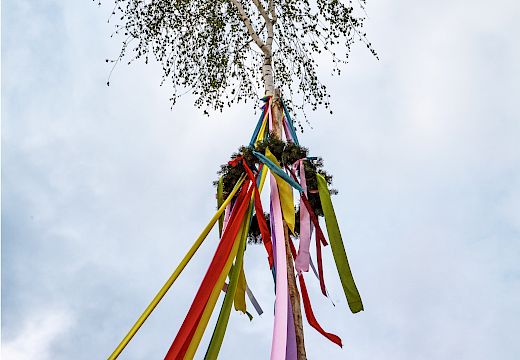
Spring custom; on the eve of 1 May, young people erect the maypole – a long, debarked tree trunk with a birch tree decorated with colourful ribbons, sometimes also a Sorbian flag, attached to its highest point, entwined with garlands and decorated with a fir wreath with ribbons below the top. In some villages in the Catholic region, Marian songs are sung after the tree has been erected. In the weeks leading up to the throwing, the maypole is guarded by the young people to prevent it from being sawn down prematurely by the youth of neighbouring villages.
In Upper Lusatia, the traditional day for throwing the maypole is a Sunday. The focus is on the competition to determine the May King. Beforehand, the young people dance under the maypole. In many places, the girls wear traditional costumes. As soon as the tree is dug up and falls, the boys run for the top. The first one is crowned May King and chooses his May Queen from among the girls. The couple leads the procession of young people through the village to the fairground or inn, where they open the dance. In Lower Lusatia, the maypole often stands until St John's Day, when it is felled and auctioned off.
Bože ćěło (Upper Sorbian) | Corpus Christi
> Saxony
On Corpus Christi (the Thursday ten days after Pentecost) and the following Sunday, processions take place in the Sorbian Catholic region.
The route to an outdoor altar is decorated with fresh grass and lined with birch trees. Churches and houses are adorned with flags, including those of the Vatican and Sorbian colours. Girls scatter flowers, and brass bands accompany the singing of hymns. Many participants wear traditional festive costumes.
Jańske rejtowanje (Lower Sorbian) | St John’s Riding
> Brandenburg
St John’s Riding is a summer custom associated with St John’s Day (24 June), formerly practised in several villages of Lower Lusatia and today preserved only in Kózłe|Casel. It is now organised by a dedicated heritage association rather than the village youth. At its centre is the figure of “Jan” (John), represented by a young man decorated with cornflowers and greenery. Wearing a crown-like headpiece, he rides with other young men from the village inn to the festival ground, accompanied by a brass band. Young women in white dresses walk ahead, carrying a second crown. After several ceremonial rides, spectators attempt to stop Jan and take flowers from him, which are considered lucky charms.
Harvest customs include various traditional riding games. The “kokot” (cockerel) appears symbolically, for example as the name for the last sheaf, decorated with flowers and ribbons. Its removal from the field marked the completion of the harvest. Women made harvest wreaths and a harvest crown, which were presented at the manor to announce the end of the harvest. This was followed by celebrations and competitions, in which the “old cockerel” was symbolically – and formerly also actually – killed.
An older form of harvest game, once widespread across Lusatia, is now practised only in a few villages of Lower Lusatia and in symbolic form. In Smogorjow | Schmogrow, young men, blindfolded and holding flails, attempt to strike a pot under which the cockerel is hidden. Each participant has three attempts. The first to hit the pot becomes king and chooses a queen from among the young women in traditional dress. The cockerel is then released, recaptured and auctioned.
The most widespread form of the game. A dead rooster is tied upside down to the crossbar of a specially constructed gate entwined with foliage. The boys gallop through the gate one after the other and try to tear off the dead rooster's head. Whoever succeeds becomes the first king ("kral"); the lads who catch the wings become the second and third kings. They receive large victor's wreaths made of oak leaves. The harvest kings choose their partners blindfolded from among the girls who are dressed in traditional dance costumes to dance the lap of honour with them. The girls determine the harvest queen from among themselves in games of skill such as the frog cart, bachelor cart or egg race. She also receives an oak leaf wreath as a prize. At the end of the competitions, a festive procession makes its way to the inn for dancing. The harvest crown, decorated with colourful ribbons, is also carried in this procession.
Originally a Whitsun custom and part of wedding traditions, Stollen Riding is now preserved as a harvest custom in Nowa Niwa | Neu Zauche. The celebration begins with a church service. In the afternoon, young men compete in horse races, riding unsaddled horses, while young women take part in skill-based games. The prizes include decorated cakes (stollen) of varying sizes.
Kolo rajtowanje (Upper Sorbian – Schleifer dialect) | Ring riding
> Saxony
In the parish of Schleife, riders competed to determine the harvest king by striking a small wreath suspended from a garland with a lance. Today, a similar custom continues in Brězowka | Halbendorf, where riders attempt to spear a ring made of oak leaves at a gallop. The winner receives a trophy, and the youth perform a circular dance in traditional attire.
Kirmes is celebrated annually in remembrance of the consecration of the church. In the past, it was the most important festival in rural society, usually lasting three days and offering opportunities for feasting, visiting relatives and dancing. Today, it is still celebrated on Sundays between St Bartholomew’s Day (24 August) and St Catherine’s Day (25 November). Family visits and festive meals remain central, and many villages also host fairground rides and stalls.
The spinning room was an important communal institution in village life. After the harvest, unmarried women gathered in the evenings to spin yarn for household linen. During this work, songs were practised for weddings and funerals. The spinning community also organised youth festivals throughout the year and was therefore a key bearer of many customs until the early 20th century. Today, the tradition continues in adapted form as a social and cultural meeting place, supporting community life and the Sorbian language.
Spěwanje na swjateho Měrćina (Upper Sorbian) | St. Martin’s singing
> Saxony
On St Martin’s Day (11 November), children in Catholic parts of Upper Lusatia go from house to house in small groups, singing traditional Sorbian verses and receiving sweets.
Borborka (Upper Sorbian) | Saint Barbara
> Saxony
On the eve of St Barbara’s Day (4 December), the figure of Borborka, dressed in a white bridal gown and accompanied by two “Ruprecht” figures, visits households with children and distributes fruit and sweets.
Swjaty Mikławš (Upper Sorbian) | Saint Nicholas
> Saxony
The custom of St Nicholas (6 December) is widespread across Germany. In some villages, St Nicholas, dressed as a bishop, visits homes and gives sweets to children. In many places, children leave their shoes out the night before to be filled. In some areas, children also go from house to house singing in return for treats.
Swjata Marija hospodu pyta (Upper Sorbian) | Saint Mary in search of shelter
> Saxony
In some Catholic villages, beginning on 15 December, a figure of the Virgin Mary (sometimes accompanied by Joseph) is passed from house to house, symbolising the biblical search for shelter. The figure remains in each household for one night. Prayers and hymns accompany its arrival and stay. The final household keeps the figure until the following Advent.
In the Schleife region, the Christ Child visits families during Advent, accompanied by two assistants. It also visits schools and care homes. Wearing festive attire inspired by bridal costume and a veil, it carries a bell and a decorated rod symbolising blessing. Without speaking, it gently touches the faces of those receiving gifts.
Nowolětka (Lower Sorbian/Upper Sorbian)
> Brandenburg, Saxony
At New Year and until Epiphany, shaped breads in the form of animals were baked and mixed into animal feed to ensure livestock health. They were also given as gifts to godchildren. Today, the custom survives in adapted form, especially in schools, nurseries and museums, where such breads are made with visitors.
Around Epiphany (6 January), public village meetings are held to review the past year. Following a report by the mayor or village head, community matters are discussed. New residents traditionally contribute by offering a round of drinks. The custom declined in the mid-20th century but has seen renewed interest since the 1990s.
This website is using cookies to provide a good browsing experience.
These include essential cookies that are necessary for the operation of the site, as well as others that are used only for anonymous statistical purposes, for comfort settings or to display personalized content. You can decide for yourself which categories you want to allow. Please note that based on your settings, not all functions of the website may be available.
Privacy Information
In the following privacy information, we, as the controller within the meaning of the General Data Protection Regulation (GDPR), explain which personal data we process when you visit our website and use our online services.
Please note that, as a standard, all data transmissions in connection with our website take place via an encrypted connection. We reserve the right to amend this privacy information from time to time to ensure that it always complies with current legal requirements or to reflect changes to our services. We therefore recommend that you read the privacy information regularly to stay informed about the protection of the personal data we process.
Controller
Domowina – Zwězk Łužyskich Serbow | Zwjazk Łužiskich Serbow | Bund Lausitzer Sorben e. V. Póstowe naměsto | Postplatz 2 Serbski dom | Haus der Sorben 02625 Budyšin | Bautzen Germany
Access to the Website, Logging and Log Files In order to access our website, the processing of your IP address and further access information is technically necessary for the duration of your session. In addition, access information is logged and stored in the server log files. This includes:
IP address
browser type and version
operating system used
referrer URL
hostname of the accessing computer
date and time of the request
Personal data is processed for the purpose of providing the website (Art. 6(1)(b) GDPR) and to ensure the security of our information technology systems (Art. 6(1)(c) GDPR in conjunction with Art. 32 GDPR). Log files are deleted after seven days at the latest.
Use of Cookies We use cookies on our website. Cookies allow us to optimise the information and services on our website for users. They enable us to recognise users of our website in order to make it easier for them to use. Cookies are used on our website in connection with the following services:
Matomo – Usage Analysis With your consent pursuant to § 25(1) TDDDG in conjunction with Art. 4 No. 11 and Art. 7 GDPR, we use the web analytics service Matomo for statistical analysis of the use of our website. The processing of personal data associated with this use is based on your consent (Art. 6(1)(a) GDPR).
Matomo uses cookies to analyse website usage. The following data in particular is processed:
anonymised IP address
date and time of page access
pages accessed and duration of visit
referrer URL
technical information about the device, browser and operating system
Processing takes place exclusively on our own server. No personal data is transferred to third parties. Data collected by Matomo is stored for six months and then deleted. It is stored solely for the purpose of analysing and optimising our website.
YouTube, Google Ireland Limited – Display of Video Content With your consent pursuant to § 25(1) TDDDG in conjunction with Art. 4 No. 11 and Art. 7 GDPR, we use the YouTube embedding function to display and play YouTube videos. The associated processing of personal data is based on your consent (Art. 6(1)(a) GDPR).
Use of YouTube involves the transfer of personal data by Google Ireland Limited to Google LLC in the United States. This transfer is based on Art. 45(1) GDPR in conjunction with the EU–U.S. Data Privacy Framework.
When video content is displayed, the user’s IP address and further browser-related information are transmitted to Google. When videos are embedded using enhanced privacy mode, no additional personal data is processed beyond this. Further information is transmitted to Google only when you actively click to play the video. If you are logged into YouTube at the time, Google assigns this information to your user account.
For details regarding the purpose and scope of data processing by Google and your rights and settings options for protecting your privacy, please refer to Google’s privacy policy.
In addition, only strictly necessary cookies pursuant to § 25(2) No. 2 TDDDG are used on our website. The subsequent processing of personal data is based on Art. 6(1)(b) GDPR for the purpose of identifying users and ensuring proper technical functionality of the content management system (“wires”, “wires_challenge”).
Other Integrated Services Darüber hinaus sind auf unserer Internetseite weitere folgende Dienste eingebunden:
Adobe Fonts, Adobe Systems Software Ireland Limited – We use Adobe Fonts (formerly Typekit), provided by Adobe Systems Software Ireland Limited, to ensure consistent font presentation. The integration of Adobe Fonts is based on our legitimate interest pursuant to Art. 6(1)(f) GDPR. This interest lies in the technically sound, consistent and visually appealing presentation of our website and licence monitoring by Adobe.
When accessing our website, connection data, including the user’s IP address, is transmitted to Adobe servers. According to Adobe, no cookies are set in connection with Adobe Fonts and the IP address is used solely to provide the fonts.
Newsletter To provide our newsletter service, we integrate a form provided by our service provider Positive Group Deutschland GmbH (Rapidmail) on the basis of legitimate interest pursuant to Art. 6(1)(f) GDPR. A data processing agreement pursuant to Art. 28 GDPR has been concluded.
Subscription to the newsletter is based on your consent (Art. 6(1)(a) GDPR). Only your email address is required. To verify your details and consent, you will receive a confirmation email (double opt-in). We log:
email address
IP address
date and time of registration and confirmation
You may withdraw your consent at any time with future effect by using the unsubscribe link included in every newsletter email. Your stored email address will then be deleted.
Contact Form Our website provides a contact form and contact via email. When you contact us, we process the personal data you provide (in particular name, email address and message) for the purpose of responding to your enquiry. Processing is based on legitimate interest (Art. 6(1)(f) GDPR) or, in the case of contractual matters, Art. 6(1)(b) GDPR.
Your data will be treated confidentially and will not be passed on to third parties unless necessary to handle your enquiry. Data is deleted once your enquiry has been fully resolved, unless statutory retention obligations apply.
Use of Service Providers We use service providers for hosting and technical support who may process personal data on our behalf or have access to it. Data processing agreements pursuant to Art. 28 GDPR have been concluded with all such providers. In addition to those already mentioned, these include:
Data Subject Rights and Right to Lodge a Complaint
You have the right to:
obtain information about your personal data
request rectification
request erasure
request restriction of processing
request data portability
Where processing is based on legitimate interests, you also have the right to object. Where processing is based on consent, you may withdraw your consent at any time with future effect. You may exercise your rights using the contact details provided above. You also have the right to lodge a complaint with a supervisory authority pursuant to Art. 77 GDPR if you believe that your personal data is being processed unlawfully.
If you would like, I can also adapt the tone slightly (more formal UK institutional, or more EU-legal neutral).
Imprint / Legal Notice
Domowina – Zwězk Łužyskich Serbow | Zwjazk Łužiskich Serbow | Bund Lausitzer Sorben e. V. Serbski dom | Haus der Sorben Póstowe naměsto | Postplatz 2 02625 Budyšin | Bautzen Germany
Register of Associations: VerR 30317 Registered Court: Dresden Local Court
Bank details: Deutsche Bank AG IBAN DE42 8 707 0000 0612 3269 00 BIC DEUTDE8CXXX
Tax number: 204/140/0277 (The association is recognised as a non-profit organisation and is exempt from corporation tax.)
Representation
Represented by Judit Šołćina Chief Executive (authorised to represent the association in accordance with its statutes)
Responsible for editorial content in accordance with Section 18 (2) of the German State Media Treaty (MStV): Božena Šimanec | Schiemann Press Officer
Domowina is the provider of the domain www.domowina.de and is responsible for the central content of the main website as well as for the technical structure of the website. Responsibility for the content (in particular texts, images, media, downloads, and external links) of the respective subpages within the multisite structure lies with the respective member organisations and regional associations.
The following organisations are responsible for the content of their respective subpages:
Maćica Serbska e. V.: dr Anja Pohončowa | Pohontsch, Chairwoman
Serbski Sokoł e. V.: Jan Hrjehor | Rehor, Chairman
Society for the Promotion of a Sorbian Cultural and Information Centre in Berlin – SKI e. V.: Cyril Pjech | Cyrill Pech, Chairman
Association for the Promotion of Sorbian Folk Culture e. V.: Franciska Grajcarekowa | Franziska Grajcarek, Chairwoman
Association of Sorbian Craftspeople and Entrepreneurs e. V.: Mónika Cyžowa | Monika Ziesch, Chairwoman
Association of Sorbian Choir e. V.: Pětr Cyž | Peter Ziesch, Chairman
Sorbian Artists’ Association e. V.: Jan Bělk | Bilk, Chairman
Association of Sorbian Students: Matej Mark, Chairman
Liability for Content The contents of this website have been created with the greatest possible care. However, Domowina – Zwězk Łužyskich Serbow | Zwjazk Łužiskich Serbow | Bund Lausitzer Sorben e. V. accepts no liability for the accuracy, completeness or timeliness of the information provided. We reserve the right to amend, supplement or delete content at any time.
Liability for Links This website contains links to external third-party websites over whose content we have no control. We therefore accept no liability for such external content. The respective operators of the linked sites are solely responsible for their content. At the time the links were created, no unlawful content was identifiable.
Content and Copyright: The layout, design, photographs and editorial contributions on this website are protected by copyright. Any reuse or reproduction is permitted for private purposes only. Alterations to the content are not permitted. Public use, publication or distribution of content requires prior consent from Domowina – Zwězk Łužyskich Serbow | Zwjazk Łužiskich Serbow | Bund Lausitzer Sorben e. V.
Official announcements and press releases issued by Domowina may be used provided the source is acknowledged. The regional and member associations of Domowina are solely responsible for the content of their respective websites.
Consumer Dispute Resolution / Universal Arbitration Board We are neither willing nor obliged to participate in dispute resolution proceedings before a consumer arbitration board.
Data Protection Information on data protection can be found in our Privacy Policy.
Funded by
The Domowina – Federation of Lusatian Sorbs is institutionally funded by the Foundation for the Sorbian People, which receives annual grants from public funds on the basis of the approved budgets of the German Bundestag, the Brandenburg State Parliament, and the Saxon State Parliament. www.stiftung.sorben.com
This website is using cookies to provide a good browsing experience.
These include essential cookies that are necessary for the operation of the site, as well as others that are used only for anonymous statistical purposes, for comfort settings or to display personalized content. You can decide for yourself which categories you want to allow. Please note that based on your settings, not all functions of the website may be available.
Privacy Information
In the following privacy information, we, as the controller within the meaning of the General Data Protection Regulation (GDPR), explain which personal data we process when you visit our website and use our online services.
Please note that, as a standard, all data transmissions in connection with our website take place via an encrypted connection. We reserve the right to amend this privacy information from time to time to ensure that it always complies with current legal requirements or to reflect changes to our services. We therefore recommend that you read the privacy information regularly to stay informed about the protection of the personal data we process.
Controller
Domowina – Zwězk Łužyskich Serbow | Zwjazk Łužiskich Serbow | Bund Lausitzer Sorben e. V. Póstowe naměsto | Postplatz 2 Serbski dom | Haus der Sorben 02625 Budyšin | Bautzen Germany
Access to the Website, Logging and Log Files In order to access our website, the processing of your IP address and further access information is technically necessary for the duration of your session. In addition, access information is logged and stored in the server log files. This includes:
IP address
browser type and version
operating system used
referrer URL
hostname of the accessing computer
date and time of the request
Personal data is processed for the purpose of providing the website (Art. 6(1)(b) GDPR) and to ensure the security of our information technology systems (Art. 6(1)(c) GDPR in conjunction with Art. 32 GDPR). Log files are deleted after seven days at the latest.
Use of Cookies We use cookies on our website. Cookies allow us to optimise the information and services on our website for users. They enable us to recognise users of our website in order to make it easier for them to use. Cookies are used on our website in connection with the following services:
Matomo – Usage Analysis With your consent pursuant to § 25(1) TDDDG in conjunction with Art. 4 No. 11 and Art. 7 GDPR, we use the web analytics service Matomo for statistical analysis of the use of our website. The processing of personal data associated with this use is based on your consent (Art. 6(1)(a) GDPR).
Matomo uses cookies to analyse website usage. The following data in particular is processed:
anonymised IP address
date and time of page access
pages accessed and duration of visit
referrer URL
technical information about the device, browser and operating system
Processing takes place exclusively on our own server. No personal data is transferred to third parties. Data collected by Matomo is stored for six months and then deleted. It is stored solely for the purpose of analysing and optimising our website.
YouTube, Google Ireland Limited – Display of Video Content With your consent pursuant to § 25(1) TDDDG in conjunction with Art. 4 No. 11 and Art. 7 GDPR, we use the YouTube embedding function to display and play YouTube videos. The associated processing of personal data is based on your consent (Art. 6(1)(a) GDPR).
Use of YouTube involves the transfer of personal data by Google Ireland Limited to Google LLC in the United States. This transfer is based on Art. 45(1) GDPR in conjunction with the EU–U.S. Data Privacy Framework.
When video content is displayed, the user’s IP address and further browser-related information are transmitted to Google. When videos are embedded using enhanced privacy mode, no additional personal data is processed beyond this. Further information is transmitted to Google only when you actively click to play the video. If you are logged into YouTube at the time, Google assigns this information to your user account.
For details regarding the purpose and scope of data processing by Google and your rights and settings options for protecting your privacy, please refer to Google’s privacy policy.
In addition, only strictly necessary cookies pursuant to § 25(2) No. 2 TDDDG are used on our website. The subsequent processing of personal data is based on Art. 6(1)(b) GDPR for the purpose of identifying users and ensuring proper technical functionality of the content management system (“wires”, “wires_challenge”).
Other Integrated Services Darüber hinaus sind auf unserer Internetseite weitere folgende Dienste eingebunden:
Adobe Fonts, Adobe Systems Software Ireland Limited – We use Adobe Fonts (formerly Typekit), provided by Adobe Systems Software Ireland Limited, to ensure consistent font presentation. The integration of Adobe Fonts is based on our legitimate interest pursuant to Art. 6(1)(f) GDPR. This interest lies in the technically sound, consistent and visually appealing presentation of our website and licence monitoring by Adobe.
When accessing our website, connection data, including the user’s IP address, is transmitted to Adobe servers. According to Adobe, no cookies are set in connection with Adobe Fonts and the IP address is used solely to provide the fonts.
Newsletter To provide our newsletter service, we integrate a form provided by our service provider Positive Group Deutschland GmbH (Rapidmail) on the basis of legitimate interest pursuant to Art. 6(1)(f) GDPR. A data processing agreement pursuant to Art. 28 GDPR has been concluded.
Subscription to the newsletter is based on your consent (Art. 6(1)(a) GDPR). Only your email address is required. To verify your details and consent, you will receive a confirmation email (double opt-in). We log:
email address
IP address
date and time of registration and confirmation
You may withdraw your consent at any time with future effect by using the unsubscribe link included in every newsletter email. Your stored email address will then be deleted.
Contact Form Our website provides a contact form and contact via email. When you contact us, we process the personal data you provide (in particular name, email address and message) for the purpose of responding to your enquiry. Processing is based on legitimate interest (Art. 6(1)(f) GDPR) or, in the case of contractual matters, Art. 6(1)(b) GDPR.
Your data will be treated confidentially and will not be passed on to third parties unless necessary to handle your enquiry. Data is deleted once your enquiry has been fully resolved, unless statutory retention obligations apply.
Use of Service Providers We use service providers for hosting and technical support who may process personal data on our behalf or have access to it. Data processing agreements pursuant to Art. 28 GDPR have been concluded with all such providers. In addition to those already mentioned, these include:
Data Subject Rights and Right to Lodge a Complaint
You have the right to:
obtain information about your personal data
request rectification
request erasure
request restriction of processing
request data portability
Where processing is based on legitimate interests, you also have the right to object. Where processing is based on consent, you may withdraw your consent at any time with future effect. You may exercise your rights using the contact details provided above. You also have the right to lodge a complaint with a supervisory authority pursuant to Art. 77 GDPR if you believe that your personal data is being processed unlawfully.
If you would like, I can also adapt the tone slightly (more formal UK institutional, or more EU-legal neutral).
Imprint / Legal Notice
Domowina – Zwězk Łužyskich Serbow | Zwjazk Łužiskich Serbow | Bund Lausitzer Sorben e. V. Serbski dom | Haus der Sorben Póstowe naměsto | Postplatz 2 02625 Budyšin | Bautzen Germany
Register of Associations: VerR 30317 Registered Court: Dresden Local Court
Bank details: Deutsche Bank AG IBAN DE42 8 707 0000 0612 3269 00 BIC DEUTDE8CXXX
Tax number: 204/140/0277 (The association is recognised as a non-profit organisation and is exempt from corporation tax.)
Representation
Represented by Judit Šołćina Chief Executive (authorised to represent the association in accordance with its statutes)
Responsible for editorial content in accordance with Section 18 (2) of the German State Media Treaty (MStV): Božena Šimanec | Schiemann Press Officer
Domowina is the provider of the domain www.domowina.de and is responsible for the central content of the main website as well as for the technical structure of the website. Responsibility for the content (in particular texts, images, media, downloads, and external links) of the respective subpages within the multisite structure lies with the respective member organisations and regional associations.
The following organisations are responsible for the content of their respective subpages:
Maćica Serbska e. V.: dr Anja Pohončowa | Pohontsch, Chairwoman
Serbski Sokoł e. V.: Jan Hrjehor | Rehor, Chairman
Society for the Promotion of a Sorbian Cultural and Information Centre in Berlin – SKI e. V.: Cyril Pjech | Cyrill Pech, Chairman
Association for the Promotion of Sorbian Folk Culture e. V.: Franciska Grajcarekowa | Franziska Grajcarek, Chairwoman
Association of Sorbian Craftspeople and Entrepreneurs e. V.: Mónika Cyžowa | Monika Ziesch, Chairwoman
Association of Sorbian Choir e. V.: Pětr Cyž | Peter Ziesch, Chairman
Sorbian Artists’ Association e. V.: Jan Bělk | Bilk, Chairman
Association of Sorbian Students: Matej Mark, Chairman
Liability for Content The contents of this website have been created with the greatest possible care. However, Domowina – Zwězk Łužyskich Serbow | Zwjazk Łužiskich Serbow | Bund Lausitzer Sorben e. V. accepts no liability for the accuracy, completeness or timeliness of the information provided. We reserve the right to amend, supplement or delete content at any time.
Liability for Links This website contains links to external third-party websites over whose content we have no control. We therefore accept no liability for such external content. The respective operators of the linked sites are solely responsible for their content. At the time the links were created, no unlawful content was identifiable.
Content and Copyright: The layout, design, photographs and editorial contributions on this website are protected by copyright. Any reuse or reproduction is permitted for private purposes only. Alterations to the content are not permitted. Public use, publication or distribution of content requires prior consent from Domowina – Zwězk Łužyskich Serbow | Zwjazk Łužiskich Serbow | Bund Lausitzer Sorben e. V.
Official announcements and press releases issued by Domowina may be used provided the source is acknowledged. The regional and member associations of Domowina are solely responsible for the content of their respective websites.
Consumer Dispute Resolution / Universal Arbitration Board We are neither willing nor obliged to participate in dispute resolution proceedings before a consumer arbitration board.
Data Protection Information on data protection can be found in our Privacy Policy.
Funded by
The Domowina – Federation of Lusatian Sorbs is institutionally funded by the Foundation for the Sorbian People, which receives annual grants from public funds on the basis of the approved budgets of the German Bundestag, the Brandenburg State Parliament, and the Saxon State Parliament. www.stiftung.sorben.com
Your cookie preferences have been saved.
To load this element, it is required to consent to the following cookie category: {category}.