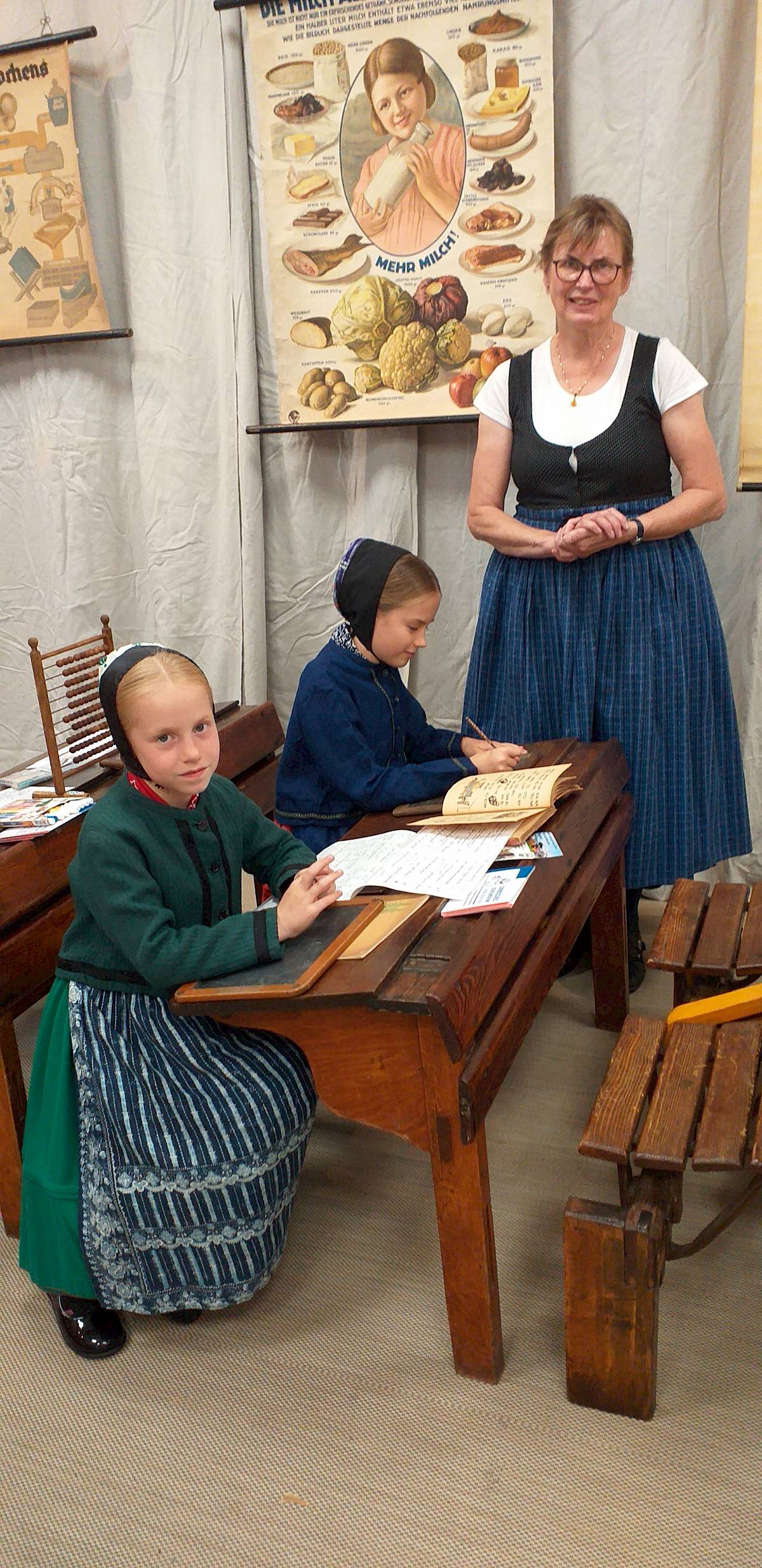
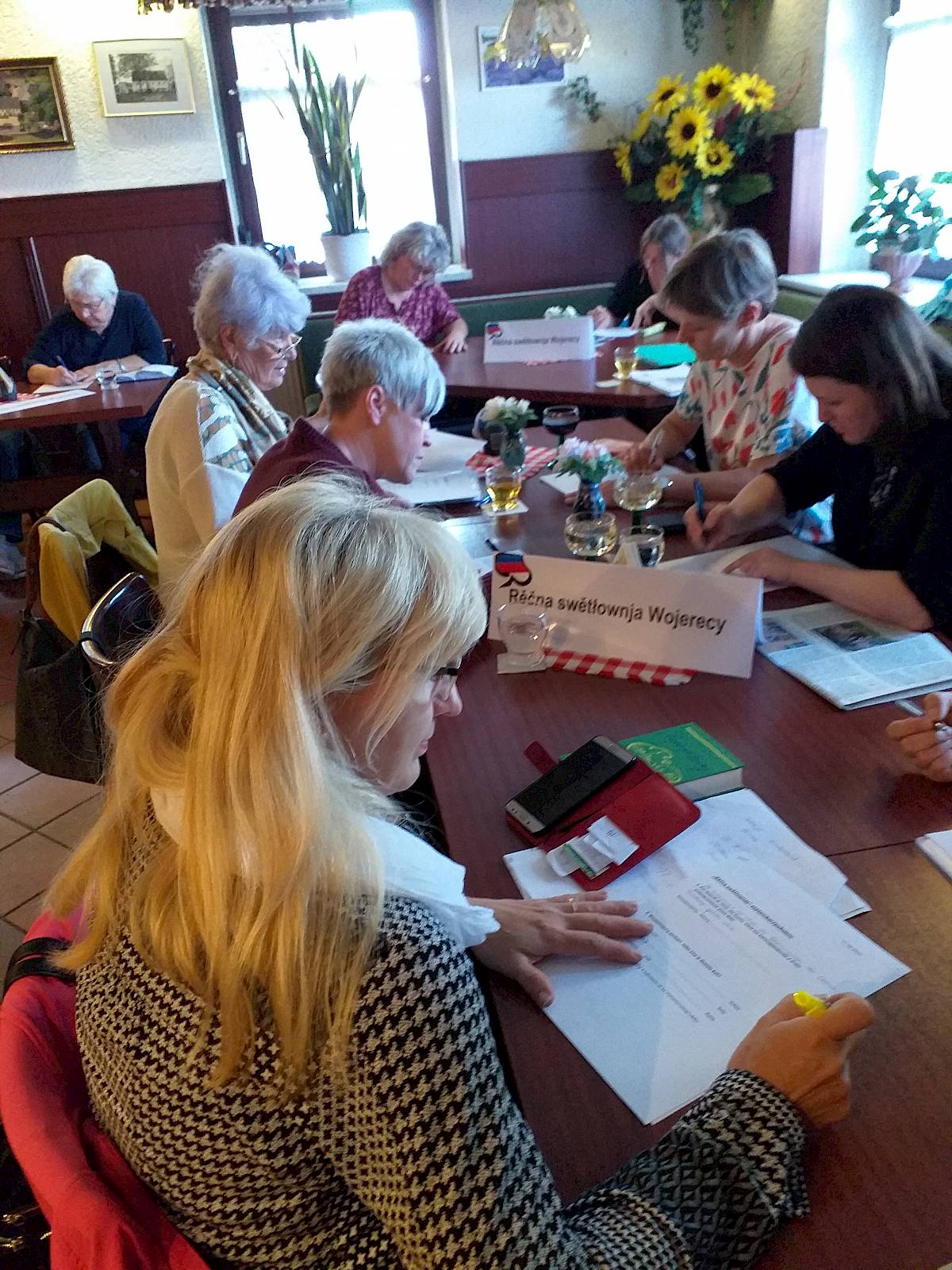
Der Domowina – Regionalverband "Handrij Zejler" vereint Vereine, Ortsgruppen und Kulturinitiativen, die sich für die sorbische Sprache und Kultur in der Region engagieren. Mit Veranstaltungen, Projekten und gelebten Traditionen stärken wir das Gemeinschaftsgefühl und machen sorbisches Leben heute sichtbar.
Der Regionalverband im Wandel
Wojerecy | Hoyerswerda besitzt für die sorbische Geschichte herausragende Bedeutung, denn hier riefen 60 Vertreter von 31 sorbischen Vereinen aus der ganzen Lausitz am 13. Oktober 1912 die Domowina, den Zwjazk Łužiskich Serbow | Bund Lausitzer Sorben ins Leben. Ort der Gründungsversammlung war das Hoyerswerdaer Ball- und Gesellschaftshaus in der Braugasse, heute Sitz der „Kulturfabrik“ (Kufa). Am 19.07.2021 wurde im Rathaus von Hoyerswerda mit einem Festakt der Gründung von vier Domowina – Regionalverbänden vor hundert Jahren gedacht. Eine Gedenktafel am Rathaus wurde enthüllt.
Sorben und Deutsche leben gleichberechtigt miteinander. In Sachsen und in Brandenburg ist der Schutz der sorbischen Sprache und Kultur in der jeweiligen Landesverfassung ausdrücklich festgeschrieben. Das zeigt, dass sich beide Bundesländer ihres besonderen, lebendigen kulturellen Schatzes sehr bewusst sind.
Die Bikulturalität und Zweisprachigkeit der Region Wojerecy | Hoyerswerda sind ein Alleinstellungsmerkmal. Der Domowina – Regionalverband "Handrij Zejler" arbeitet sukzessive daran, diesen Schatz gemeinsam mit den Mitgliedsvereinen und Partnern zu bewahren und zu fördern. Das Sächsische Sorbengesetz liefert die rechtlichen Rahmenbedingungen.
Der Domowina – Regionalverband "Handrij Zejler" steht für gelebte Gemeinschaft zwischen Mehrheit und Minderheit und engagiert sich, die sorbische Sprache und Kultur in einer modernen Gesellschaft lebendig zu halten.
Engagement für Sprachräume und Kultur
Dem Regionalverband gehören aktuell fünf Ortsgruppen und 14 Vereine an. Diese gestalten ein vielfältiges Programm:
Sprachkurse
Sorbische Gesprächskreise
Öffentliche Lesungen, Vorträge, Heimatfeste und Herbstkonzerte
Familiennachmittage, bei denen die sorbische Sprache im Mittelpunkt steht
In vielen Familien wurde die sorbische Sprache kaum weitergetragen. Die Veranstaltungen bieten Gelegenheiten, die Sprache wieder zu hören, Sprachkenntnisse aufzufrischen und vorhandene Sprachräume zu nutzen und weiter auszubauen. Dabei unterstützen derzeit Sprachmotivatoren.
Historische Entwicklung
1912 entstand in Wojerecy | Hoyerswerda die Domowina, der Bund Lausitzer Sorben, als Dachorganisation von 31 sorbischen Vereinen. Durch den fortschreitenden Bergbau in der Lausitz verschwand eine Reihe sorbischer Dörfer, vor allem in der Mittellausitz, was mit einem weiteren Niedergang der sorbischen Dorfkultur, Traditionen, Brauchtum und vor allem der sorbischen Sprache verbunden war.
Die Sorben haben eine eigene lebendige Sprache und Kultur. Dabei hat das um Wojerecy | Hoyerswerda und Budyšin | Bautzen gesprochene Obersorbisch stärkere Ähnlichkeiten mit dem Tschechischen, das um Chóśebuz |Cottbus gesprochene Niedersorbisch neigt eher zum Polnischen.
Der fortschreitende Bergbau in den letzten hundert Jahren, insbesondere der Bau des Braunkohlekraftwerkes Schwarze Pumpe, hat viele Wunden und Narben hinterlassen. Der nördliche und östliche Teil des ehemaligen Kreises Wojerecy | Hoyerswerda sind vom Bergbau besonders in Mitleidenschaft gezogen worden. Tausende Hektar Wald und landwirtschaftlicher Fläche sind ihm zum Opfer gefallen. Viele sorbische Dörfer wurden weggebaggert. Die bäuerliche und sorbische Identität des Kreises ist dadurch stark gemindert worden. Dies sind Gründe dafür, dass in der Region Wojerecy | Hoyerswerda d die Weitergabe der sorbischen Sprache in der Familie und im Alltag in den letzten 70 Jahren nach und nach verlorenging.
This website is using cookies to provide a good browsing experience.
These include essential cookies that are necessary for the operation of the site, as well as others that are used only for anonymous statistical purposes, for comfort settings or to display personalized content. You can decide for yourself which categories you want to allow. Please note that based on your settings, not all functions of the website may be available.
Privacy Information
In the following privacy information, we, as the controller within the meaning of the General Data Protection Regulation (GDPR), explain which personal data we process when you visit our website and use our online services.
Please note that, as a standard, all data transmissions in connection with our website take place via an encrypted connection. We reserve the right to amend this privacy information from time to time to ensure that it always complies with current legal requirements or to reflect changes to our services. We therefore recommend that you read the privacy information regularly to stay informed about the protection of the personal data we process.
Controller
Domowina – Zwězk Łužyskich Serbow | Zwjazk Łužiskich Serbow | Bund Lausitzer Sorben e. V. Póstowe naměsto | Postplatz 2 Serbski dom | Haus der Sorben 02625 Budyšin | Bautzen Germany
Access to the Website, Logging and Log Files In order to access our website, the processing of your IP address and further access information is technically necessary for the duration of your session. In addition, access information is logged and stored in the server log files. This includes:
IP address
browser type and version
operating system used
referrer URL
hostname of the accessing computer
date and time of the request
Personal data is processed for the purpose of providing the website (Art. 6(1)(b) GDPR) and to ensure the security of our information technology systems (Art. 6(1)(c) GDPR in conjunction with Art. 32 GDPR). Log files are deleted after seven days at the latest.
Use of Cookies We use cookies on our website. Cookies allow us to optimise the information and services on our website for users. They enable us to recognise users of our website in order to make it easier for them to use. Cookies are used on our website in connection with the following services:
Matomo – Usage Analysis With your consent pursuant to § 25(1) TDDDG in conjunction with Art. 4 No. 11 and Art. 7 GDPR, we use the web analytics service Matomo for statistical analysis of the use of our website. The processing of personal data associated with this use is based on your consent (Art. 6(1)(a) GDPR).
Matomo uses cookies to analyse website usage. The following data in particular is processed:
anonymised IP address
date and time of page access
pages accessed and duration of visit
referrer URL
technical information about the device, browser and operating system Processing takes place exclusively on our own server. No personal data is transferred to third parties. Data collected by Matomo is stored for six months and then deleted. It is stored solely for the purpose of analysing and optimising our website.
Google Search Console We use Google Search Console, a service provided by Google Ireland Limited, Gordon House, Barrow Street, Dublin 4, Ireland. Google Search Console helps us analyse the visibility of our website in Google Search and identify technical and content-related opportunities for optimisation. In particular, Google Search Console provides us with information about the search queries through which our website appears in or is accessed via Google Search, as well as statistical data such as impressions, clicks, click-through rates and average position. Based on our current technical implementation, the use of Google Search Console on our website does not set any additional cookies or use any additional tracking technologies on users' devices. The data obtained through Google Search Console is also analysed within our web analytics system, Matomo. For this purpose, the search and performance data made available by Google Search Console is imported into Matomo via a server-side API. No visitor data collected by Matomo is transferred to Google as part of this process. The processing is carried out on the basis of Article 6(1)(f) GDPR. Our legitimate interest lies in analysing and improving the visibility, technical discoverability and user-friendliness of our website.
YouTube, Google Ireland Limited – Display of Video Content With your consent pursuant to § 25(1) TDDDG in conjunction with Art. 4 No. 11 and Art. 7 GDPR, we use the YouTube embedding function to display and play YouTube videos. The associated processing of personal data is based on your consent (Art. 6(1)(a) GDPR).
Use of YouTube involves the transfer of personal data by Google Ireland Limited to Google LLC in the United States. This transfer is based on Art. 45(1) GDPR in conjunction with the EU–U.S. Data Privacy Framework.
When video content is displayed, the user’s IP address and further browser-related information are transmitted to Google. When videos are embedded using enhanced privacy mode, no additional personal data is processed beyond this. Further information is transmitted to Google only when you actively click to play the video. If you are logged into YouTube at the time, Google assigns this information to your user account.
For details regarding the purpose and scope of data processing by Google and your rights and settings options for protecting your privacy, please refer to Google’s privacy policy.
In addition, only strictly necessary cookies pursuant to § 25(2) No. 2 TDDDG are used on our website. The subsequent processing of personal data is based on Art. 6(1)(b) GDPR for the purpose of identifying users and ensuring proper technical functionality of the content management system (“wires”, “wires_challenge”).
Other Integrated Services Darüber hinaus sind auf unserer Internetseite weitere folgende Dienste eingebunden:
Adobe Fonts, Adobe Systems Software Ireland Limited – We use Adobe Fonts (formerly Typekit), provided by Adobe Systems Software Ireland Limited, to ensure consistent font presentation. The integration of Adobe Fonts is based on our legitimate interest pursuant to Art. 6(1)(f) GDPR. This interest lies in the technically sound, consistent and visually appealing presentation of our website and licence monitoring by Adobe.
When accessing our website, connection data, including the user’s IP address, is transmitted to Adobe servers. According to Adobe, no cookies are set in connection with Adobe Fonts and the IP address is used solely to provide the fonts.
Newsletter To provide our newsletter service, we integrate a form provided by our service provider Positive Group Deutschland GmbH (Rapidmail) on the basis of legitimate interest pursuant to Art. 6(1)(f) GDPR. A data processing agreement pursuant to Art. 28 GDPR has been concluded.
Subscription to the newsletter is based on your consent (Art. 6(1)(a) GDPR). Only your email address is required. To verify your details and consent, you will receive a confirmation email (double opt-in). We log:
email address
IP address
date and time of registration and confirmation
You may withdraw your consent at any time with future effect by using the unsubscribe link included in every newsletter email. Your stored email address will then be deleted.
Contact Form Our website provides a contact form and contact via email. When you contact us, we process the personal data you provide (in particular name, email address and message) for the purpose of responding to your enquiry. Processing is based on legitimate interest (Art. 6(1)(f) GDPR) or, in the case of contractual matters, Art. 6(1)(b) GDPR.
Your data will be treated confidentially and will not be passed on to third parties unless necessary to handle your enquiry. Data is deleted once your enquiry has been fully resolved, unless statutory retention obligations apply.
Use of Service Providers We use service providers for hosting and technical support who may process personal data on our behalf or have access to it. Data processing agreements pursuant to Art. 28 GDPR have been concluded with all such providers. In addition to those already mentioned, these include:
Data Subject Rights and Right to Lodge a Complaint
You have the right to:
obtain information about your personal data
request rectification
request erasure
request restriction of processing
request data portability
Where processing is based on legitimate interests, you also have the right to object. Where processing is based on consent, you may withdraw your consent at any time with future effect. You may exercise your rights using the contact details provided above. You also have the right to lodge a complaint with a supervisory authority pursuant to Art. 77 GDPR if you believe that your personal data is being processed unlawfully.
If you would like, I can also adapt the tone slightly (more formal UK institutional, or more EU-legal neutral).
Imprint / Legal Notice
Domowina – Zwězk Łužyskich Serbow | Zwjazk Łužiskich Serbow | Bund Lausitzer Sorben e. V. Serbski dom | Haus der Sorben Póstowe naměsto | Postplatz 2 02625 Budyšin | Bautzen Germany
Register of Associations: VerR 30317 Registered Court: Dresden Local Court
Bank details: Deutsche Bank AG IBAN DE42 8 707 0000 0612 3269 00 BIC DEUTDE8CXXX
Tax number: 204/140/0277 (The association is recognised as a non-profit organisation and is exempt from corporation tax.)
Representation
Represented by Judit Šołćina Chief Executive (authorised to represent the association in accordance with its statutes)
Responsible for editorial content in accordance with Section 18 (2) of the German State Media Treaty (MStV): Božena Šimanec | Schiemann Press Officer
Domowina is the provider of the domain www.domowina.de and is responsible for the central content of the main website as well as for the technical structure of the website. Responsibility for the content (in particular texts, images, media, downloads, and external links) of the respective subpages within the multisite structure lies with the respective member organisations and regional associations.
The following organisations are responsible for the content of their respective subpages:
Maćica Serbska e. V.: dr Anja Pohončowa | Pohontsch, Chairwoman
Serbski Sokoł e. V.: Jan Hrjehor | Rehor, Chairman
Society for the Promotion of a Sorbian Cultural and Information Centre in Berlin – SKI e. V.: Cyril Pjech | Cyrill Pech, Chairman
Association for the Promotion of Sorbian Folk Culture e. V.: Franciska Grajcarekowa | Franziska Grajcarek, Chairwoman
Association of Sorbian Craftspeople and Entrepreneurs e. V.: Mónika Cyžowa | Monika Ziesch, Chairwoman
Association of Sorbian Choir e. V.: Pětr Cyž | Peter Ziesch, Chairman
Sorbian Artists’ Association e. V.: Jan Bělk | Bilk, Chairman
Association of Sorbian Students: Matej Mark, Chairman
Liability for Content The contents of this website have been created with the greatest possible care. However, Domowina – Zwězk Łužyskich Serbow | Zwjazk Łužiskich Serbow | Bund Lausitzer Sorben e. V. accepts no liability for the accuracy, completeness or timeliness of the information provided. We reserve the right to amend, supplement or delete content at any time.
Liability for Links This website contains links to external third-party websites over whose content we have no control. We therefore accept no liability for such external content. The respective operators of the linked sites are solely responsible for their content. At the time the links were created, no unlawful content was identifiable.
Content and Copyright: The layout, design, photographs and editorial contributions on this website are protected by copyright. Any reuse or reproduction is permitted for private purposes only. Alterations to the content are not permitted. Public use, publication or distribution of content requires prior consent from Domowina – Zwězk Łužyskich Serbow | Zwjazk Łužiskich Serbow | Bund Lausitzer Sorben e. V.
Official announcements and press releases issued by Domowina may be used provided the source is acknowledged. The regional and member associations of Domowina are solely responsible for the content of their respective websites.
Consumer Dispute Resolution / Universal Arbitration Board We are neither willing nor obliged to participate in dispute resolution proceedings before a consumer arbitration board.
Data Protection Information on data protection can be found in our Privacy Policy.
Funded by
The Domowina – Federation of Lusatian Sorbs is institutionally funded by the Foundation for the Sorbian People, which receives annual grants from public funds on the basis of the approved budgets of the German Bundestag, the Brandenburg State Parliament, and the Saxon State Parliament. www.stiftung.sorben.com
This website is using cookies to provide a good browsing experience.
These include essential cookies that are necessary for the operation of the site, as well as others that are used only for anonymous statistical purposes, for comfort settings or to display personalized content. You can decide for yourself which categories you want to allow. Please note that based on your settings, not all functions of the website may be available.
Privacy Information
In the following privacy information, we, as the controller within the meaning of the General Data Protection Regulation (GDPR), explain which personal data we process when you visit our website and use our online services.
Please note that, as a standard, all data transmissions in connection with our website take place via an encrypted connection. We reserve the right to amend this privacy information from time to time to ensure that it always complies with current legal requirements or to reflect changes to our services. We therefore recommend that you read the privacy information regularly to stay informed about the protection of the personal data we process.
Controller
Domowina – Zwězk Łužyskich Serbow | Zwjazk Łužiskich Serbow | Bund Lausitzer Sorben e. V. Póstowe naměsto | Postplatz 2 Serbski dom | Haus der Sorben 02625 Budyšin | Bautzen Germany
Access to the Website, Logging and Log Files In order to access our website, the processing of your IP address and further access information is technically necessary for the duration of your session. In addition, access information is logged and stored in the server log files. This includes:
IP address
browser type and version
operating system used
referrer URL
hostname of the accessing computer
date and time of the request
Personal data is processed for the purpose of providing the website (Art. 6(1)(b) GDPR) and to ensure the security of our information technology systems (Art. 6(1)(c) GDPR in conjunction with Art. 32 GDPR). Log files are deleted after seven days at the latest.
Use of Cookies We use cookies on our website. Cookies allow us to optimise the information and services on our website for users. They enable us to recognise users of our website in order to make it easier for them to use. Cookies are used on our website in connection with the following services:
Matomo – Usage Analysis With your consent pursuant to § 25(1) TDDDG in conjunction with Art. 4 No. 11 and Art. 7 GDPR, we use the web analytics service Matomo for statistical analysis of the use of our website. The processing of personal data associated with this use is based on your consent (Art. 6(1)(a) GDPR).
Matomo uses cookies to analyse website usage. The following data in particular is processed:
anonymised IP address
date and time of page access
pages accessed and duration of visit
referrer URL
technical information about the device, browser and operating system Processing takes place exclusively on our own server. No personal data is transferred to third parties. Data collected by Matomo is stored for six months and then deleted. It is stored solely for the purpose of analysing and optimising our website.
Google Search Console We use Google Search Console, a service provided by Google Ireland Limited, Gordon House, Barrow Street, Dublin 4, Ireland. Google Search Console helps us analyse the visibility of our website in Google Search and identify technical and content-related opportunities for optimisation. In particular, Google Search Console provides us with information about the search queries through which our website appears in or is accessed via Google Search, as well as statistical data such as impressions, clicks, click-through rates and average position. Based on our current technical implementation, the use of Google Search Console on our website does not set any additional cookies or use any additional tracking technologies on users' devices. The data obtained through Google Search Console is also analysed within our web analytics system, Matomo. For this purpose, the search and performance data made available by Google Search Console is imported into Matomo via a server-side API. No visitor data collected by Matomo is transferred to Google as part of this process. The processing is carried out on the basis of Article 6(1)(f) GDPR. Our legitimate interest lies in analysing and improving the visibility, technical discoverability and user-friendliness of our website.
YouTube, Google Ireland Limited – Display of Video Content With your consent pursuant to § 25(1) TDDDG in conjunction with Art. 4 No. 11 and Art. 7 GDPR, we use the YouTube embedding function to display and play YouTube videos. The associated processing of personal data is based on your consent (Art. 6(1)(a) GDPR).
Use of YouTube involves the transfer of personal data by Google Ireland Limited to Google LLC in the United States. This transfer is based on Art. 45(1) GDPR in conjunction with the EU–U.S. Data Privacy Framework.
When video content is displayed, the user’s IP address and further browser-related information are transmitted to Google. When videos are embedded using enhanced privacy mode, no additional personal data is processed beyond this. Further information is transmitted to Google only when you actively click to play the video. If you are logged into YouTube at the time, Google assigns this information to your user account.
For details regarding the purpose and scope of data processing by Google and your rights and settings options for protecting your privacy, please refer to Google’s privacy policy.
In addition, only strictly necessary cookies pursuant to § 25(2) No. 2 TDDDG are used on our website. The subsequent processing of personal data is based on Art. 6(1)(b) GDPR for the purpose of identifying users and ensuring proper technical functionality of the content management system (“wires”, “wires_challenge”).
Other Integrated Services Darüber hinaus sind auf unserer Internetseite weitere folgende Dienste eingebunden:
Adobe Fonts, Adobe Systems Software Ireland Limited – We use Adobe Fonts (formerly Typekit), provided by Adobe Systems Software Ireland Limited, to ensure consistent font presentation. The integration of Adobe Fonts is based on our legitimate interest pursuant to Art. 6(1)(f) GDPR. This interest lies in the technically sound, consistent and visually appealing presentation of our website and licence monitoring by Adobe.
When accessing our website, connection data, including the user’s IP address, is transmitted to Adobe servers. According to Adobe, no cookies are set in connection with Adobe Fonts and the IP address is used solely to provide the fonts.
Newsletter To provide our newsletter service, we integrate a form provided by our service provider Positive Group Deutschland GmbH (Rapidmail) on the basis of legitimate interest pursuant to Art. 6(1)(f) GDPR. A data processing agreement pursuant to Art. 28 GDPR has been concluded.
Subscription to the newsletter is based on your consent (Art. 6(1)(a) GDPR). Only your email address is required. To verify your details and consent, you will receive a confirmation email (double opt-in). We log:
email address
IP address
date and time of registration and confirmation
You may withdraw your consent at any time with future effect by using the unsubscribe link included in every newsletter email. Your stored email address will then be deleted.
Contact Form Our website provides a contact form and contact via email. When you contact us, we process the personal data you provide (in particular name, email address and message) for the purpose of responding to your enquiry. Processing is based on legitimate interest (Art. 6(1)(f) GDPR) or, in the case of contractual matters, Art. 6(1)(b) GDPR.
Your data will be treated confidentially and will not be passed on to third parties unless necessary to handle your enquiry. Data is deleted once your enquiry has been fully resolved, unless statutory retention obligations apply.
Use of Service Providers We use service providers for hosting and technical support who may process personal data on our behalf or have access to it. Data processing agreements pursuant to Art. 28 GDPR have been concluded with all such providers. In addition to those already mentioned, these include:
Data Subject Rights and Right to Lodge a Complaint
You have the right to:
obtain information about your personal data
request rectification
request erasure
request restriction of processing
request data portability
Where processing is based on legitimate interests, you also have the right to object. Where processing is based on consent, you may withdraw your consent at any time with future effect. You may exercise your rights using the contact details provided above. You also have the right to lodge a complaint with a supervisory authority pursuant to Art. 77 GDPR if you believe that your personal data is being processed unlawfully.
If you would like, I can also adapt the tone slightly (more formal UK institutional, or more EU-legal neutral).
Imprint / Legal Notice
Domowina – Zwězk Łužyskich Serbow | Zwjazk Łužiskich Serbow | Bund Lausitzer Sorben e. V. Serbski dom | Haus der Sorben Póstowe naměsto | Postplatz 2 02625 Budyšin | Bautzen Germany
Register of Associations: VerR 30317 Registered Court: Dresden Local Court
Bank details: Deutsche Bank AG IBAN DE42 8 707 0000 0612 3269 00 BIC DEUTDE8CXXX
Tax number: 204/140/0277 (The association is recognised as a non-profit organisation and is exempt from corporation tax.)
Representation
Represented by Judit Šołćina Chief Executive (authorised to represent the association in accordance with its statutes)
Responsible for editorial content in accordance with Section 18 (2) of the German State Media Treaty (MStV): Božena Šimanec | Schiemann Press Officer
Domowina is the provider of the domain www.domowina.de and is responsible for the central content of the main website as well as for the technical structure of the website. Responsibility for the content (in particular texts, images, media, downloads, and external links) of the respective subpages within the multisite structure lies with the respective member organisations and regional associations.
The following organisations are responsible for the content of their respective subpages:
Maćica Serbska e. V.: dr Anja Pohončowa | Pohontsch, Chairwoman
Serbski Sokoł e. V.: Jan Hrjehor | Rehor, Chairman
Society for the Promotion of a Sorbian Cultural and Information Centre in Berlin – SKI e. V.: Cyril Pjech | Cyrill Pech, Chairman
Association for the Promotion of Sorbian Folk Culture e. V.: Franciska Grajcarekowa | Franziska Grajcarek, Chairwoman
Association of Sorbian Craftspeople and Entrepreneurs e. V.: Mónika Cyžowa | Monika Ziesch, Chairwoman
Association of Sorbian Choir e. V.: Pětr Cyž | Peter Ziesch, Chairman
Sorbian Artists’ Association e. V.: Jan Bělk | Bilk, Chairman
Association of Sorbian Students: Matej Mark, Chairman
Liability for Content The contents of this website have been created with the greatest possible care. However, Domowina – Zwězk Łužyskich Serbow | Zwjazk Łužiskich Serbow | Bund Lausitzer Sorben e. V. accepts no liability for the accuracy, completeness or timeliness of the information provided. We reserve the right to amend, supplement or delete content at any time.
Liability for Links This website contains links to external third-party websites over whose content we have no control. We therefore accept no liability for such external content. The respective operators of the linked sites are solely responsible for their content. At the time the links were created, no unlawful content was identifiable.
Content and Copyright: The layout, design, photographs and editorial contributions on this website are protected by copyright. Any reuse or reproduction is permitted for private purposes only. Alterations to the content are not permitted. Public use, publication or distribution of content requires prior consent from Domowina – Zwězk Łužyskich Serbow | Zwjazk Łužiskich Serbow | Bund Lausitzer Sorben e. V.
Official announcements and press releases issued by Domowina may be used provided the source is acknowledged. The regional and member associations of Domowina are solely responsible for the content of their respective websites.
Consumer Dispute Resolution / Universal Arbitration Board We are neither willing nor obliged to participate in dispute resolution proceedings before a consumer arbitration board.
Data Protection Information on data protection can be found in our Privacy Policy.
Funded by
The Domowina – Federation of Lusatian Sorbs is institutionally funded by the Foundation for the Sorbian People, which receives annual grants from public funds on the basis of the approved budgets of the German Bundestag, the Brandenburg State Parliament, and the Saxon State Parliament. www.stiftung.sorben.com
Your cookie preferences have been saved.
To load this element, it is required to consent to the following cookie category: {category}.